
Acadia Women's Health
September 20, 2026
min read
Breast augmentation is one of the most common cosmetic surgeries, but if you are considering it, you may still be unclear on what the procedure actually involves. Understanding the steps, the choices, and the trade-offs makes it much easier to walk into a consultation prepared.
It is also a well-established procedure. Breast augmentation was the second most common cosmetic surgery in the United States in 2024, according to the American Society of Plastic Surgeons. The first modern implants were developed in the early 1960s, and the technique has been refined ever since.
At Acadia Women's Health in Crowley, Louisiana, we help women across Acadiana think through this decision with clear, honest information. This article walks you through your options, where the incision goes, how the implant is placed, what the day of surgery looks like, recovery, and the risks worth knowing.
At its simplest, breast augmentation is surgery to increase breast size or change breast shape. Most of the time that means placing an implant. Some women choose fat transfer instead, where fat is gently removed from another area of your body and injected into the breast.
Fat transfer works best for a modest change of about one cup size. Implants give a more predictable jump in volume in a single operation.
If you go with implants, your first big choice is saline versus silicone. Both have a silicone outer shell. The difference is what fills them and how they feel, so it helps to see them side by side.
Implant type
What it is
Good to know
Saline
Filled with sterile salt water
Firmer feel, and inserted empty then filled, which allows a smaller incision. Deflates visibly if it leaks, and the body absorbs the salt water
Silicone gel
Filled with a soft silicone gel
Feels the most like natural breast tissue. A leak can be quiet, so imaging is used to check it over time
Gummy bear
A thicker, form-stable silicone gel
Holds its shape even if the shell breaks. The shaped versions need a slightly longer incision
At Acadia Women's Health, our surgeons work with smooth, round saline and silicone implants and match the choice to your goals and your body. Shape and projection matter too. Round implants add more fullness up top, while teardrop-shaped implants follow the natural slope of the breast. A higher-profile implant projects further forward for a fuller look, and a lower profile is subtler.
Size is where a lot of women get stuck, and that is completely normal. Implants are measured in cubic centimeters, not cup sizes. Cup sizing is not standardized, so it is only a rough guide. As one study found, roughly 130 to 150 cc adds about one cup size. On our own site we note that the most natural-looking results usually land between 300 and 500 cc, though the right number always depends on your frame.
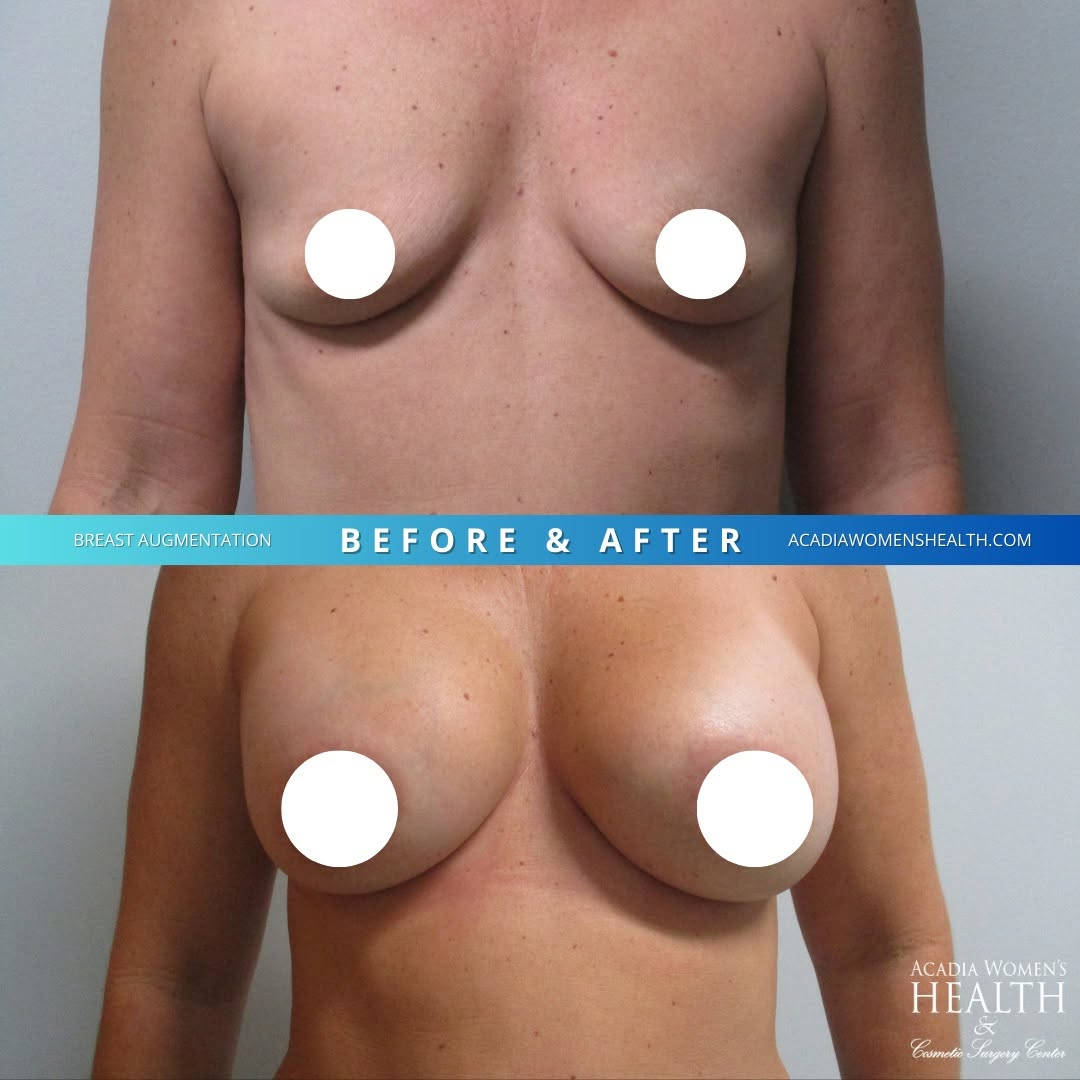
Want to see what different choices actually look like on real women? You can browse our before-and-after gallery to get a feel for the range.
Every implant has to go in through a small opening, and where that opening is placed shapes how visible your scar will be. Surgeons generally choose from three spots, and it helps to understand what each one means for you.
The most common is the inframammary incision, made in the natural fold under the breast. It gives the surgeon a direct path to build the pocket. It also lets the scar settle into the crease, where a bra or swimsuit hides it.
A second approach some surgeons use is the periareolar incision, made along the lower edge of the areola. It can blend with the color change there, but because it sits close to the nerves and milk ducts, it carries a higher chance of changed nipple feeling. A 2026 review of more than 13,000 patients found this approach had about a threefold higher risk of reduced nipple sensation than the fold incision.
The third option, the transaxillary incision, is tucked into the armpit. It leaves no scar on the breast itself, though the scar shows in the underarm instead.
At Acadia Women's Health, our surgeons place the breast augmentation incision in the fold under the breast. Using the fold keeps the scar hidden in the crease and gives clear access to position the implant well. Saline implants help here too, since they go in empty and are filled once in place, which allows a smaller opening.
It is worth saying plainly that some scars are part of any surgery. What a skilled surgeon can do is place that scar where it is easy to hide and hard to notice, so it fades into the background of your day-to-day life.
Once the incision is planned, the next question is which layer the implant sits in. Under the muscle, called submuscular, means the implant rests partly beneath the chest muscle. Over the muscle, called subglandular, means it sits just behind your breast tissue and on top of the muscle. Neither one is wrong in general, and surgeons weigh tissue thickness, coverage, and recovery differently.
Placing the implant under the muscle gives it more natural tissue and muscle coverage on top, which creates a smoother, more natural-looking transition, especially if you have thinner breast tissue to start. There is a health advantage too. A large analysis found that under-the-muscle placement had a lower rate of capsular contracture, which is a tightening of scar tissue around the implant. The trade-off is that recovery tends to feel a little more tender at first, since the muscle needs time to settle.
Over-the-muscle placement usually means a quicker, more comfortable early recovery because the muscle is left alone. It can be a good fit for women who already have enough natural tissue to cover the implant smoothly. Our surgeons place the implant beneath the chest muscle. Your surgeon will look at your tissue thickness and explain how that placement will sit on your frame.
Placement also touches two practical things worth knowing. It can affect how sore you feel in the first week. It can also affect future mammograms, since implants can make the images a little harder to read.
If your main goal is more size and your breasts still sit high, you may not need a lift at all. If they have started to sag, our surgeons may suggest pairing your augmentation with a breast lift so the result looks balanced. The clearest way to know which path fits you is a personal exam, where a provider looks at your tissue and your goals together.
The day of surgery is the part most women are nervous about, and knowing the order of events takes a lot of the fear out of it. You will arrive after your fasting instructions, get checked in, change into a gown, and meet the team who will care for you before anything begins.
Then comes anesthesia. Most breast augmentations are done under general anesthesia, which means you are asleep and feel nothing during the surgery. Some procedures are done with tumescent (local) anesthesia instead, so you stay awake but comfortable while the area being treated is numbed.
Our practice was built by co-founders Dr. John Gonzalez and Dr. Michelle Owens. Dr. Gonzalez is board certified in obstetrics and gynecology by the American Board of Obstetrics and Gynecology, and he is a Fellow of the American Academy of Cosmetic Surgery with more than 25 years of experience. He was one of the first surgeons in the Acadiana area to perform breast augmentation in the office under local anesthesia.
Once you are comfortable, the surgeon makes the planned incision, gently creates the pocket beneath the chest muscle, and places the implant. Saline implants are filled once they are in position, while silicone implants come prefilled. The incisions are then closed with layered stitches under the skin, plus stitches, surgical tape, or skin glue on top.
Start to finish, the surgery itself usually takes about one to two hours. Afterward you wake up in a recovery area where the team watches over you until you are steady, and most women head home the same day with someone to drive them. These surgeries are performed in our own accredited surgical suites, where more than 5,000 cosmetic surgeries have been done.
Adelaide went into her surgery day nervous and came out feeling cared for every step of the way.
"I was very anxious about the actual surgery part because I haven't had a surgery in so long and he held my hand every step of the way and kept the most infectious positive attitude as well."
The first day or two after surgery, expect to feel groggy from the anesthesia, with some soreness, tightness, swelling, and bruising across the chest. That is your body doing exactly what it should. You will rest, take the pain medicine you are given, and keep activity light while the worst of the tenderness passes.
From there, recovery is a gradual return to normal life. Many women are back to desk work and driving in about one to two weeks, though anything strenuous waits longer and depends on your job and how you feel. You will wear a soft, supportive surgical bra that works like a gentle splint, easing swelling and helping everything settle into place.
Scars fade with time and a little care. Scar treatment starts only after the skin has fully closed, and then research supports silicone gel or silicone sheets for softening how a scar looks. Sun protection matters too, since a fresh scar can darken in the sun.
We talk through scar care with you before surgery and check in as you heal, so you are never left guessing about what is normal.
Because these are out-of-pocket cosmetic procedures, we offer flexible financing through Cherry, Affirm, and CareCredit, so the total can be spread into manageable monthly payments. We can talk through the options with you at your consultation.
Breast implants are considered safe for many women, but they are not a set-it-and-forget-it device, and an honest look at the risks is part of a good decision. The main things to understand are capsular contracture, breast implant illness, and the reality that implants need monitoring over time.
Capsular contracture happens when the natural scar capsule around the implant tightens and hardens, which can cause firmness, discomfort, or a change in shape. Mild cases are often just watched. Firmer cases are usually treated with a small procedure to release or remove the capsule, often with an implant exchange.
Some women also report a cluster of symptoms like fatigue and joint pain that is sometimes called breast implant illness. It is not yet a formal diagnosis, but the experience is real to those who have it. It is worth raising at your consultation so you can talk it through with your provider.
Finally, implants are not lifetime devices. The American Society of Plastic Surgeons points to FDA guidance on monitoring. It recommends an MRI or ultrasound about five to six years after silicone implants, then every two to three years, to check that everything is intact.
None of this should scare you off. It should give you the full picture, so you can make this decision with real confidence.
Samantha felt heard and unhurried while she worked through her decision.
"She was incredibly caring and sweet, and most importantly, she truly listened. Every concern I had was taken seriously, and she took the time to explain everything and make sure I felt confident moving forward. I never once felt rushed or unsure."
If you started this article curious but a little unsure, hopefully the breast augmentation process feels less like a mystery now and more like a set of choices you can make with a clear head. Wanting to understand every step before you commit is exactly the right instinct.
When you are ready, a good next step is to look through real before-and-after photos and then reach out to our team for a free consultation. There is no pressure to decide that day. It is simply your chance to ask questions and see what is realistic for you.
At Acadia Women's Health in Crowley, we understand the body you have and the body you want. The team here takes the time to help women across Acadiana feel comfortable and confident, with no pressure to decide before you are ready. When you are ready to talk, call us at 337-785-2006.
Both have a silicone shell, but saline implants are filled with sterile salt water and silicone implants are filled with a soft gel. Silicone tends to feel more like natural breast tissue, while saline deflates noticeably if it leaks so a problem is easy to spot. A silicone leak can be quiet, which is why imaging is used to check silicone implants over time.
Many women breastfeed just fine after augmentation, though surgery can sometimes affect the nerves and milk ducts. Placing the implant under the muscle usually affects milk supply less than placing it over the muscle. If breastfeeding in the future matters to you, tell your surgeon so it can shape the plan.
Acadia Women's Health lists breast augmentation starting at $3,600. That is a starting price and does not include meds ($75), labs ($75), or the facility fee ($200), which brings the total for saline implants to $3,950. Because every plan is different, your exact cost is reviewed at your free consultation.
No, there is no strict rule that implants must come out at 10 years. They are not lifetime devices, though, so future surgery to adjust or replace them is common. Regular check-ups and imaging help you and your surgeon decide if and when a change makes sense.
You can expect soreness, tightness, and tenderness in the first several days, especially with under-the-muscle placement. Your surgeon prescribes pain medicine and gives you a plan to stay ahead of the discomfort. Most women find the sharpest pain eases within the first few days and settles into a manageable ache.
Yes. If your goal is mainly more size and your breasts still sit in a good position, an augmentation on its own is often all you need. A lift is usually suggested only when the breasts sag or the skin is quite loose. Your provider can tell you which fits your body after a simple exam.
With saline, a rupture is usually obvious because the breast loses size and shape as the salt water is absorbed. A silicone leak can be silent, with little visible change, and may only show up on imaging. Any new pain, swelling, firmness, or change in shape is worth having checked.
Implants can make mammograms a bit harder to read, so always tell the technologist you have implants and they will take extra, specialized views. If you have silicone implants, your surgeon may also recommend an ultrasound or MRI on a regular schedule. Keeping up with screening stays important after augmentation.
Yes, and it is common. Combining an implant with a lift, sometimes called augmentation with mastopexy, adds volume and raises the breasts in one surgery. It is a good option when you want both more fullness and a higher position, and it saves you a second recovery.
Implants are measured in cubic centimeters rather than cup sizes, since cup sizing varies from brand to brand. The right size depends on your chest width, your height, and the look you are going for. At your free consultation, our team helps you try sizers and look at photos so the number is based on your real frame, not a guess.
Disclaimer: This article is for general educational purposes only and is not medical advice. Reading it does not create a physician-patient relationship. Every patient is different, individual results vary, and no outcome is guaranteed. Talk with a qualified physician about your specific situation before making any treatment decision.
Written by
Cosmetic Surgeon, Board-Certified Urogynecologist
Fellow of the American Academy of Cosmetic Surgeons; Fellow of the American College of Obstetricians and Gynecologists. Medical Degree: University of Miami School of Medicine; Residency: Orlando Regional Healthcare System as Chief Resident.
Our board-certified team offers personalized, judgment-free consultations to help you decide what's right for you.
RECENT POST
BROWSE BY CATEGORY
VISIT US
527 Odd Fellows Road STE B
Crowley, LA 70526
(337) 514-4369
Mon – Thu 8:00 – 5:00
Friday 8:00 – 12:00
%20(SM).png)
(sm).png)
(SM).png)