Acadia Women's Health
November 3, 2026
min read
A breast augmentation result is shaped by the body it starts with, which is why two women who choose the same implant can look different afterward. Implants add volume, projection, and fullness at the top of the breast, but they do not raise tissue that sits low, move a nipple, or change the width of your chest. Wanting to know how your own result will look is a fair thing to settle before you commit.
In its 2025 statistics report, the American Society of Plastic Surgeons found that 36 percent of member surgeons saw patients trending toward smaller implants, while 12 percent saw a shift toward larger ones. The most common implant range those surgeons reported was 300 to 400 cc. Proportion, not size for its own sake, is what most women are asking for now.
At Acadia Women's Health in Crowley, Louisiana, we perform breast augmentation in our own accredited surgical suites. We talk through your goals, your options, and what is realistic for your body before anything is decided. This article covers what the surgery can and cannot change, how your frame and implant choices shape the look, what healing looks like, how to read before-and-after photos, and how long results last.
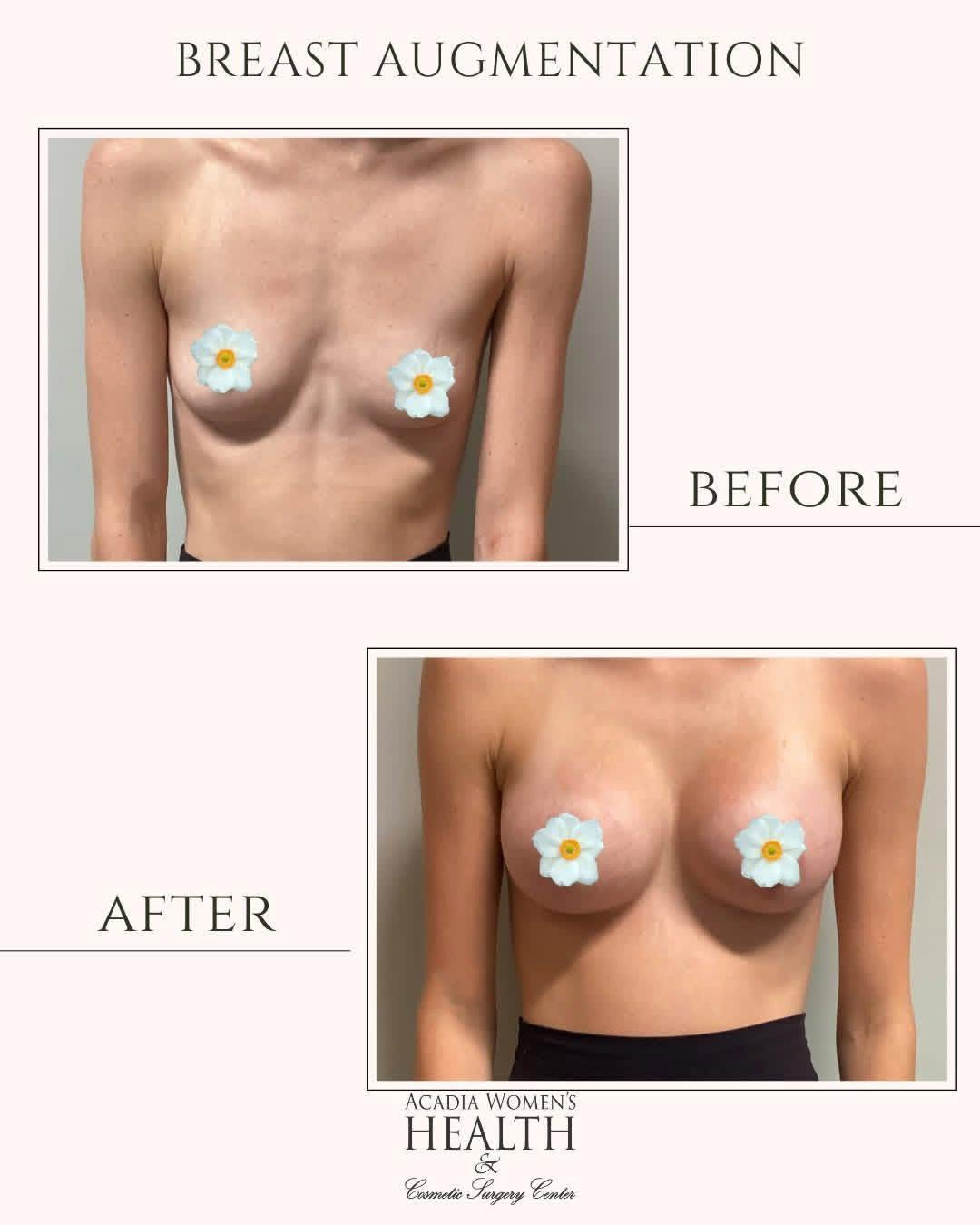
Breast augmentation makes the breast fuller, adds forward projection, and restores fullness at the top of the breast, where volume tends to disappear first. An implant is a volume device. It fills the skin and breast tissue you already have, so the shape you end up with is your own shape with more volume behind it.
For women whose breasts changed after pregnancy or breastfeeding, that is good news when the main problem is deflation, because an implant puts the fullness back.
What an implant cannot do is remove stretched skin or move a nipple that sits low. In a 10-year study that measured breast photos, augmentation added projection and fullness at the top of the breast, those changes were still there a decade later, and the nipple did not move.
Repositioning the nipple is what a breast lift does, with or without an implant.
Your main concern
What augmentation alone does
When a lift is added
Lost fullness, nipple still centered
Restores volume and projection
Usually not needed
Nipple points down or sits below the fold
Adds size without raising the breast
A lift repositions the tissue and nipple
One breast noticeably larger
A different implant size on each side improves balance
Sometimes a lift on one side only
Loose skin plus lost volume
Fills the breast but cannot tighten skin
Lift and implants together
Balance is the honest word for asymmetry. Almost every woman has one breast that is a little larger, and a different implant volume on each side is the most common way to even them out. No surgeon can promise mathematical symmetry, and a result that looks balanced in a bra and a swimsuit is the goal.
You might be wondering, "What if mine look fake?" That worry is fair, and the answer is proportion, which is where the surgeon's planning comes in. Dr. John Gonzalez, MD, FAACS, FACOG, performs breast augmentation in our accredited in-office suites and has cared for women in Crowley since 1999.
He is board certified in obstetrics and gynecology by the American Board of Obstetrics and Gynecology, which is part of the American Board of Medical Specialties. He is also a Fellow of the American Academy of Cosmetic Surgery. The plan he builds starts from your frame rather than from a photo of someone else.
The final look is a fit between an implant and the body it goes into, not a cup-size conversion. Your surgeon measures the width of the breast base and looks at where the fold under the breast sits. He also checks how much natural tissue will cover the implant and how much your skin can stretch. Those measurements set the range of implant widths that will look natural on you.
Cup size is a poor planning tool because a C in one bra brand is a B in another. The American Society of Plastic Surgeons notes that a 200 cc implant adds about one cup size on average, and a 400 cc implant about two. Profile is how far the implant projects forward for a given width, so a higher profile gives more forward fullness and a lower profile looks softer.
Shape matters less than many women expect. In a 3-D study in the Journal of Clinical Medicine, implant size changed breast contour significantly, while round versus teardrop shape did not. At Acadia Women's Health we use smooth, round implants, and we place them below the chest muscle. Placing the implant under the muscle adds a layer of tissue over it, which creates a smoother slope from the chest into the breast and makes rippling less likely to show.
Uneven breasts are the norm rather than the exception. In a series of 2,051 women, about half had some asymmetry. Many were treated with equal implants, and 272 received a different size on each side.
Your free consultation is where all of this gets worked out. It is a one-on-one visit with one of our providers, with no pressure to decide anything that day. You will have time to talk through your goals, the sizes and profiles that suit your frame, what healing looks like, and how to pay for it.
We offer financing through Cherry, Affirm, and CareCredit, plus in-house layaway plans, and each is explained on our financing page. After surgery, our cosmetic surgery patients get the surgeon's personal cell number, so a question at nine at night does not have to wait until morning.
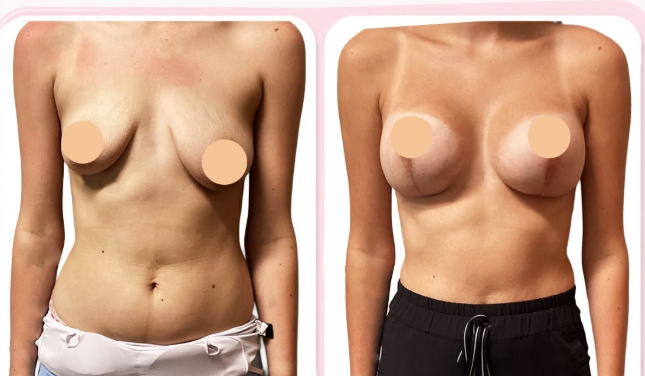
Your breasts will not look finished when you leave the recovery room, and that is normal. In the first week they are swollen, firm, and tight, and they sit high on the chest. They can look too round or uneven from side to side because the implant has not settled into its pocket yet.
Around week two the swelling and tightness start to ease. Between weeks four and six the lower part of the breast begins to soften and fill, and the exaggerated fullness at the top comes down. Surgeons call this drop and fluff.
Drop means the implant moves down from its early high position as the muscle relaxes, and fluff means the tissue over it softens and rounds out. One side often settles before the other.
Time after surgery
What you will typically see
First week
Swollen, tight, high on the chest, often uneven
Weeks 2 to 6
Swelling eases, lower breast softens, implants begin to drop
Months 3 to 6
Most settling done, shape close to final
Months 6 to 12
Fully settled, scar faded to a thin line
In a 3-D scanning study, breast volume had stabilized by three months after surgery, while most of the change in contour was complete by six months.
Your incision is tucked into the fold under the breast, where most bras and tops cover it completely. It looks pink or slightly raised for the first couple of months, then flattens and fades to a pale line over six to 12 months. We talk through scar care before surgery and check in as you heal, and sun protection is the one habit that makes the biggest difference while the scar is fresh.
You will have a series of follow-up visits so your surgeon can watch how you are healing. Between those visits you can message the team or manage appointments through the patient portal. Let us know right away if one breast swells suddenly, if pain gets worse instead of better, or if you notice redness, heat, or fever. Most of those turn out to be normal healing, and the check is worth it.
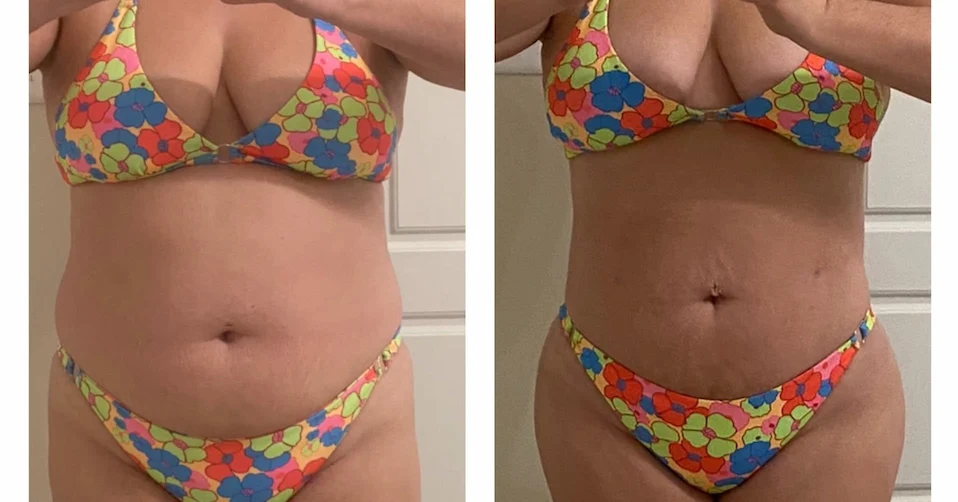
Adelaide had a breast augmentation as part of a combined procedure at our Crowley office and could already see where her result was headed at two weeks.
"The results are SO natural with the breast augmentation and that's EXACTLY what I wanted and for someone who has always had a stubborn mid section to see a flat stomach on me has just been mind-blowing. I'm only two weeks out and can already see how fine and thin the scar will be, he really couldn't have done a more beautiful job and you can see the true attention to detail he has with his work."
A before-and-after photo is most useful when the woman in it started where you are starting. Look for a similar amount of natural breast tissue, a similar chest width, and the same kind of concern. A photo of a woman with a different starting point tells you what her implant did for her, not what it would do for you.
Photography changes more than most people realize. In a review of 161 before-and-after sets on Instagram, 70.8 percent were tilted in favor of the after image through a more flattering background, angle, clothing, or pose.
Standards are lower than you would hope. A separate audit of 2,020 clinical photos scored the average post at four out of nine on photography standards, with roughly 40 percent in the low-quality range. Timing was one of the details most often left out, and it matters, because an after photo at two weeks still shows swelling. A trustworthy after photo is usually taken at six months or later.
A case worth trusting will show you:
Every gallery shows the practice's best work, so treat it as a set of examples, not a promise of what you will get. The useful question at a consultation is what a typical result looks like for a woman with your anatomy. At Acadia Women's Health, our gallery shows real patients treated at our Crowley office, with both saline and silicone cases, and it is meant to be a matching tool.
Breast augmentation results last for many years, but the breast around the implant keeps changing the way it always would. Pregnancy fills the breast and then lets it deflate afterward, breastfeeding can reduce volume, and a large weight change stretches or empties the skin. The implant holds its volume through all of that, so an augmented breast that has aged usually looks like a full breast that has settled lower.
That is also why an implant does not prevent future drooping. It adds volume, and it does not tighten skin. If the tissue drifts lower over the years, a breast lift later on can reposition it, with the same implants or new ones.
Implants themselves are not lifetime devices. Many last 10 to 15 years or longer, but there is no fixed date when they must come out. Reasons for a later exchange include a rupture, a saline implant that deflates, a capsule that tightens, an implant that has shifted, or simply a change in what you want.
For silicone implants, the FDA recommends an ultrasound or MRI to check for silent rupture starting five to six years after surgery, then every two to three years. Routine mammograms continue as usual. The technologist uses extra views that push the implant back so more of the breast tissue shows, sometimes called implant-displacement views.
The benefits hold up well over time. In a nationwide study of 14,514 women, women felt better about their breasts and about themselves one year after augmentation, and that was still true at four years. At Acadia Women's Health, the same team that placed your implants also handles your well-woman visits, pregnancy planning, and any cosmetic follow-up, so you never have to explain your implants to a stranger.
Most women heal without any of the issues below, and knowing what they look like is what lets you catch a small change early. The most talked-about one is capsular contracture. Your body forms a thin, soft layer of scar tissue around any implant, and in a small number of women that layer tightens, so the breast feels firm or sits higher.
In a study of 5,059 women with primary augmentation, capsular contracture occurred in 2.3 percent, and placing the implant over the muscle was the strongest risk factor. That is one reason we place implants below the muscle.
Rippling is the edge of the implant showing as a faint wave through the skin, usually along the outer or lower breast. It is more likely when there is less natural tissue over the implant, when the implant is large for the frame, and with saline or over-the-muscle placement.
An implant can also sit in the wrong spot. Bottoming out means it has slid too low and the lower breast looks stretched, and symmastia means the two pockets have drifted toward each other. Each of these can be corrected in a revision that rebuilds the pocket.
Revision over the years is not rare, and it is often a choice rather than a fix. In a six-year study of one implant brand, the overall risk of a second operation was 11.6 percent, while 82.6 percent of patients reported being highly satisfied with their implants.
You have more say in this than you might think. Before surgery, choose an implant width your tissue can cover, stay off nicotine, and be honest about the look you want. Afterward, follow your activity limits, keep every follow-up, and tell your surgeon about any new swelling, firmness, or change in shape as soon as you notice it.
Baylee chose Dr. Gonzalez for her breast augmentation.
"So glad I decided to choose Dr. Gonzalez, I am beyond happy with my results from my breast augmentation."
A realistic breast augmentation result is your own shape with the fullness put back, fitted to your frame, and settled over a few months rather than a few days. It will not be a copy of a photo, and it does not need to be. The women who love their results are the ones who understood what the surgery could and could not do before they chose it.
Spend some time with real before-and-after photos and pull the cases that started where you are. Then bring them in. When you are ready to talk it through, you can reach out to our team for a free consultation or call us at 337-514-4369, with no pressure to decide anything that day.
At Acadia Women's Health, we understand the body you have and the body you want. Women across Acadiana bring us these same questions, and we would be glad to help you figure out what is realistic for you.
You will see a fuller breast outline right away, but swelling and a high implant position hide the final look. The shape is close to final around three months and fully settled by about six months.
Drop and fluff usually starts around weeks three to four and becomes obvious by week six, when the lower breast softens and fills. Most implants finish settling between three and six months. Implants placed under the muscle can take a little longer because the muscle has to relax first.
No, and no surgeon can promise one, because bra cup sizes vary from brand to brand. Implants are chosen by volume in cc and matched to your chest width and existing tissue. Your frame decides how that volume looks on you.
Implants can bring uneven breasts much closer together, often by using a slightly different volume on each side. Perfect symmetry is not a realistic goal because breast tissue, nipple position, and the chest wall differ from side to side in almost everyone.
Usually not. An implant adds volume but does not tighten loose skin or raise a low nipple. If your nipple sits at or below the fold under your breast, an implant alone can make the breast larger without lifting it. A breast lift is the better plan in that case.
Whether a result looks natural comes down to proportion and placement, not the implant itself. An implant width that fits your chest, a moderate profile, and placement under the muscle all support a natural look. We use smooth, round implants placed below the muscle for that reason.
The implant keeps its volume, but the breast around it can stretch, deflate, or settle lower after pregnancy, breastfeeding, or a significant weight change. Many women notice little difference, and others choose a lift or an implant exchange later.
The incision sits in the fold under the breast and looks pink or slightly raised for the first few months. It flattens and fades to a thin, pale line over six to 12 months, and it keeps softening for up to two years.
No. The FDA is clear that implants are not lifetime devices and that the longer you have them, the more likely a replacement becomes. Many last 10 to 15 years or more, and there is no set date when they have to come out.
Most women enjoy their results for many years, and studies show satisfaction stays high at least four years out. Aging, gravity, pregnancy, and weight changes still affect the breast over time. Your free consultation at our Crowley office is a good place to ask what to expect for your body.
Disclaimer: This article is for general educational purposes only and is not medical advice. Reading it does not create a physician-patient relationship. Every patient is different, individual results vary, and no outcome is guaranteed. Talk with a qualified physician about your specific situation before making any treatment decision.
Written by
Cosmetic Surgeon, Board-Certified Urogynecologist
Fellow of the American Academy of Cosmetic Surgeons; Fellow of the American College of Obstetricians and Gynecologists. Medical Degree: University of Miami School of Medicine; Residency: Orlando Regional Healthcare System as Chief Resident.
Our board-certified team offers personalized, judgment-free consultations to help you decide what's right for you.
RECENT POST
BROWSE BY CATEGORY
VISIT US
527 Odd Fellows Road STE B
Crowley, LA 70526
(337) 514-4369
Mon – Thu 8:00 – 5:00
Friday 8:00 – 12:00