Acadia Women's Health
October 28, 2026
min read

Candidacy for a tummy tuck is not a test you pass or fail, though it is often described that way. It is a health and timing question, and the answer is usually specific rather than a flat yes or no. That distinction matters, because plenty of women have been told somewhere along the way to come back once they have lost more weight, and never learned what would actually change that answer.
The surgery itself is not unusual. In 2024, member surgeons of the American Society of Plastic Surgeons performed 171,064 tummy tucks in this country.
At Acadia Women's Health in Crowley, Louisiana, we have this conversation with women from across Acadiana almost every week. This article walks through what makes someone a good candidate, who is better off waiting, whether the surgery matches the thing that actually bothers you, and how that gets decided.
A good candidate has something a tummy tuck can physically remove or repair, is healthy enough for elective surgery, and is at a point in life where the result will hold. Those three pieces matter more than any number on a chart.
Start with the physical part. The surgery is built for loose lower abdominal skin, the pocket of fat that sits with it, and abdominal muscles that have stretched apart. Pregnancy and large weight changes are the two most common reasons all three show up together.
That muscle piece is the one most women have never had explained to them. The two bands of muscle down the front of your belly can separate down the middle, a bit like a zipper coming undone. Targeted physical therapy helps some women narrow that gap, but a wide separation usually stays open, which is why your stomach can still push forward after the weight is gone.
Health is the second piece. The strongest candidates are physically healthy nonsmokers at a steady weight, doing this for themselves, clear-eyed about what the surgery can and cannot do. None of that requires you to be an athlete. It means your body has what it needs to heal well.
Weight is the third, and it gets misunderstood constantly. The bar is not a goal weight, it is a weight you can maintain. Mayo Clinic suggests holding a stable weight for about 6 to 12 months before surgery, because tissue that is still changing will keep changing after the incision heals.
Then there is the honest part about expectations. You will have a permanent scar, usually placed low enough to sit under a swimsuit line, and it takes close to a year to fade as much as it is going to. Most women decide that trade is worth it, but it should be a decision you make with your eyes open, not a surprise.
If you have been doing everything right and your stomach still will not cooperate, that is not a discipline problem, and hearing that out loud helps. Diet and exercise are excellent at removing fat. Neither one shrinks skin that has already stretched or closes muscle that has already separated.
Most of the reasons a surgeon says no are reasons to wait rather than reasons to give up. Very few women are permanently ruled out. Far more are simply being asked to change one thing first.
The clearest reason to wait is the weight you still plan to lose. Mayo Clinic specifically lists planned major weight loss as a reason to reconsider timing, and the logic is simple. Losing a significant amount after surgery leaves you with new loose skin the operation already removed once.
A pregnancy you are still hoping for is the other big one. Carrying a baby stretches the muscle repair and the skin, which can soften a result you already paid for and recovered from. Waiting until your family feels complete is what makes the result last.
Nicotine deserves its own paragraph, because it is the single change with the biggest payoff. Nicotine narrows the small blood vessels that feed your skin, and skin that cannot get enough blood heals slowly and unevenly right where the incision is. Our providers will tell you exactly how long to be off it before and after surgery.
A few other things mean waiting while something gets sorted out first:
If you recognized yourself in that list, take a breath. Every item on it except the scarring is something that can improve with time, treatment, or a decision you get to make. Coming in now is usually the quickest way to find out which one applies to you, and what it would take to change it.
This is the question worth asking before any other one, because "am I a candidate" and "is this the right operation for my complaint" are two different questions. A tummy tuck is very good at a specific set of problems and genuinely wrong for others.
Here is how the most common concerns line up:
What bothers you
What a tummy tuck does about it
Loose skin after pregnancy or weight loss
Removes it, along with the fat attached to it, and repositions what is left
A belly that pushes forward no matter what
Stitches the separated muscle wall back together, which flattens the profile
Lower stretch marks
Removes the ones inside the skin that comes out, usually below the navel
An old C-section scar
Often taken out and replaced by the new lower incision
Stubborn fat, but skin that still snaps back
Not the right match; fat removal on its own usually fits better
Wanting the scale to move
Not what this surgery does at all
That muscle repair has a clinical name, diastasis recti, and it is worth knowing because it changes what you should expect. A 2019 review of the research describes starting with physical therapy before considering surgery, so do not be surprised if that comes up first.
Stretch marks are the one women most want a straight answer on, so it is worth being plain. The marks that sit on the skin your surgeon removes go with it. Marks above your belly button or off to the sides stay, though they usually sit differently once everything is pulled smooth.
If the thing you keep pinching is fat and your skin still bounces back, liposuction is likely the better tool. It removes fat precisely and leaves the skin alone, which is exactly what you want when skin is not the problem. Plenty of women at Acadia Women's Health end up with some combination of the two, which is one advantage of a practice that does both in the same building.
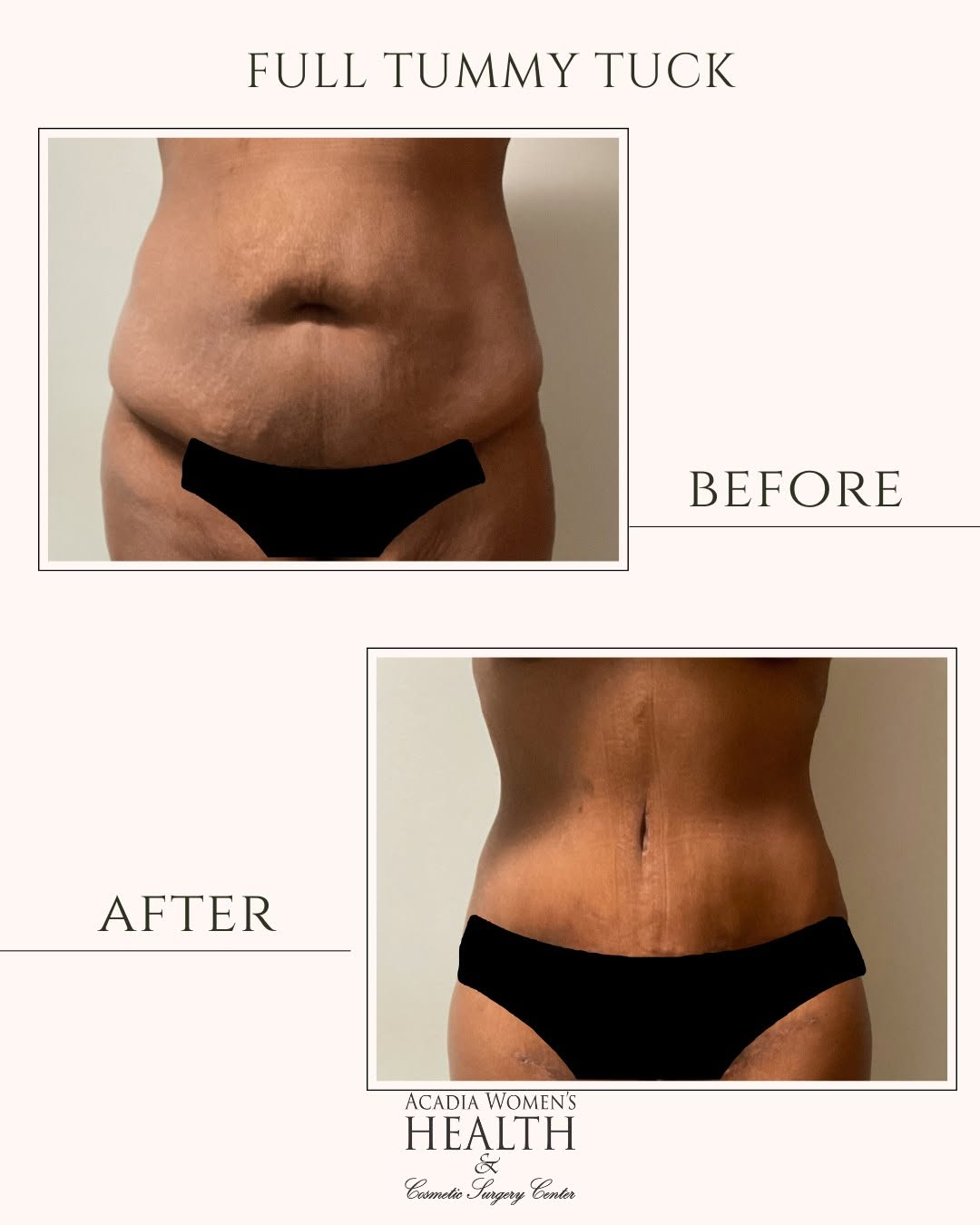
Photos help you sort this out, but only when you compare like with like. Our tummy tuck gallery is grouped by procedure, so look for women whose pregnancy or weight-loss history resembles yours rather than the most dramatic result on the page.
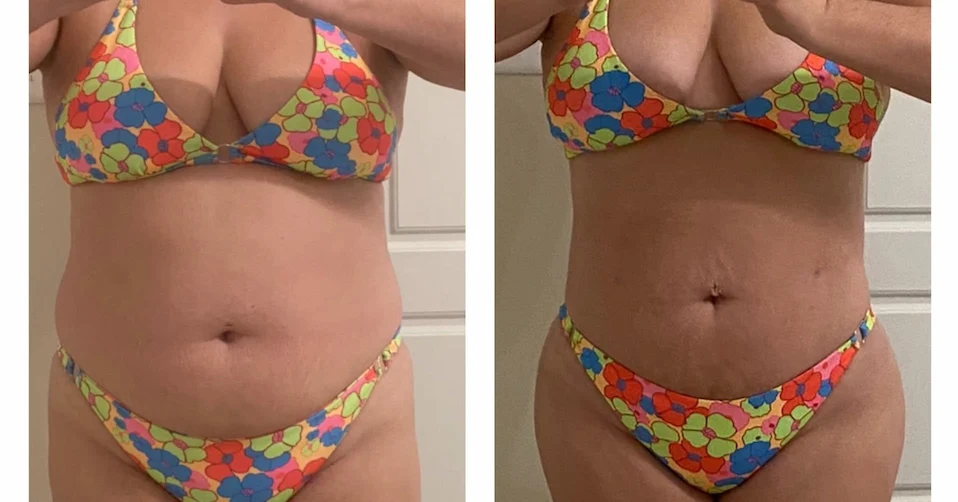
Natalie came to us after a hundred-pound weight loss, with exactly the loose skin this section is about.
"I am thrilled to share my experience with Dr. G, who performed my tummy tuck and arm lift after I lost over 100 pounds. From our first meeting, his professionalism and genuine care put me at ease."
Your consultation is free, and it is a one-on-one visit with one of our providers. Nothing about it is designed to talk you into surgery. You are evaluating us at least as much as we are evaluating you.
The first half is conversation. We go through your medical conditions, everything you take including vitamins and supplements, any allergies, and every abdominal surgery you have had, because old incisions matter to how this one gets planned.
Then comes the exam, and this is the part that actually answers your question. Your provider is checking how much loose skin there is and what quality it is, where the fat sits, whether your abdominal muscles have separated, and whether there is a hernia hiding in there. Those findings are what decide whether a full tummy tuck, a smaller skin removal, liposuction, or muscle repair is the right plan.
We will also ask about your weight over the last year and what you expect it to do next, and about whether you are finished having children. Neither question is a trap. They exist because a stable body is what makes a result last.
One more question matters more than most women expect: whose idea is this? Surgery goes best when the goal is yours. If someone else is pushing you toward it, that is worth saying out loud in the room.
Sometimes the honest answer is that a different procedure fits you better, or that something needs to settle down first. That might mean getting blood sugar steadier, adjusting a medication with your prescribing doctor, or simply holding your weight a few more months.
The surgical plan itself, meaning which technique and whether anything is staged, is decided by one of our surgeons. Our practice was founded by Dr. John Gonzalez and Dr. Michelle Owens. Both are board certified in obstetrics and gynecology by the American Board of Obstetrics and Gynecology and Fellows of the American Academy of Cosmetic Surgery. Each has spent more than 25 years caring for women in Acadiana.
Cost is part of the answer too, and we keep it straightforward. Every plan is different, so your real number comes together at the visit rather than over the phone. These are out-of-pocket cosmetic procedures and we do not file them with insurance.
That is exactly why we offer flexible payment options through Cherry, Affirm, CareCredit, and in-house layaway, plus a 4 percent discount when you pay cash.
You might be wondering, "will they actually listen, or just move me toward the biggest surgery?" It is a fair question and a common one. The honest answer is that our providers regularly tell women a smaller procedure fits better, or that waiting is the right call for now.
Once you are a patient, you can message the team, manage appointments, and check your records through the patient portal.
Knowing you qualify and knowing you are ready are not the same thing. The women who feel best about this decision are the ones who looked at the whole picture first, including the parts that ask something of them.
Start with what the surgery gives you. In a study following 63 tummy tuck patients, more than 84 percent were very satisfied with how they looked afterward. Another 93.4 percent said they would do it again, and 88.9 percent would recommend it.
Balance that against what it asks. This is real surgery with real recovery, and the issues that come up are mostly manageable ones: fluid collecting under the skin, slower healing along part of the incision, temporary numbness across the lower belly. Blood clots are rarer and more serious, which is why movement starts on day one.
Ask your surgeon for their own numbers, not just the national ones. Any surgeon worth choosing will answer that without hesitating.
Recovery is the piece women underestimate. You need someone to drive you home and stay the first night, plus real help with lifting and with children for the first week or two. Most women take two to four weeks before they are back at work, and strenuous exercise usually waits six to eight.
Think honestly about what is ahead of you, too. A future pregnancy or a big swing in weight can soften a result, which is why timing this well is what protects the money and the recovery you put in.
Finally, choose carefully. Since a tummy tuck is elective, you get to be picky, and the questions below are the ones actually worth asking:
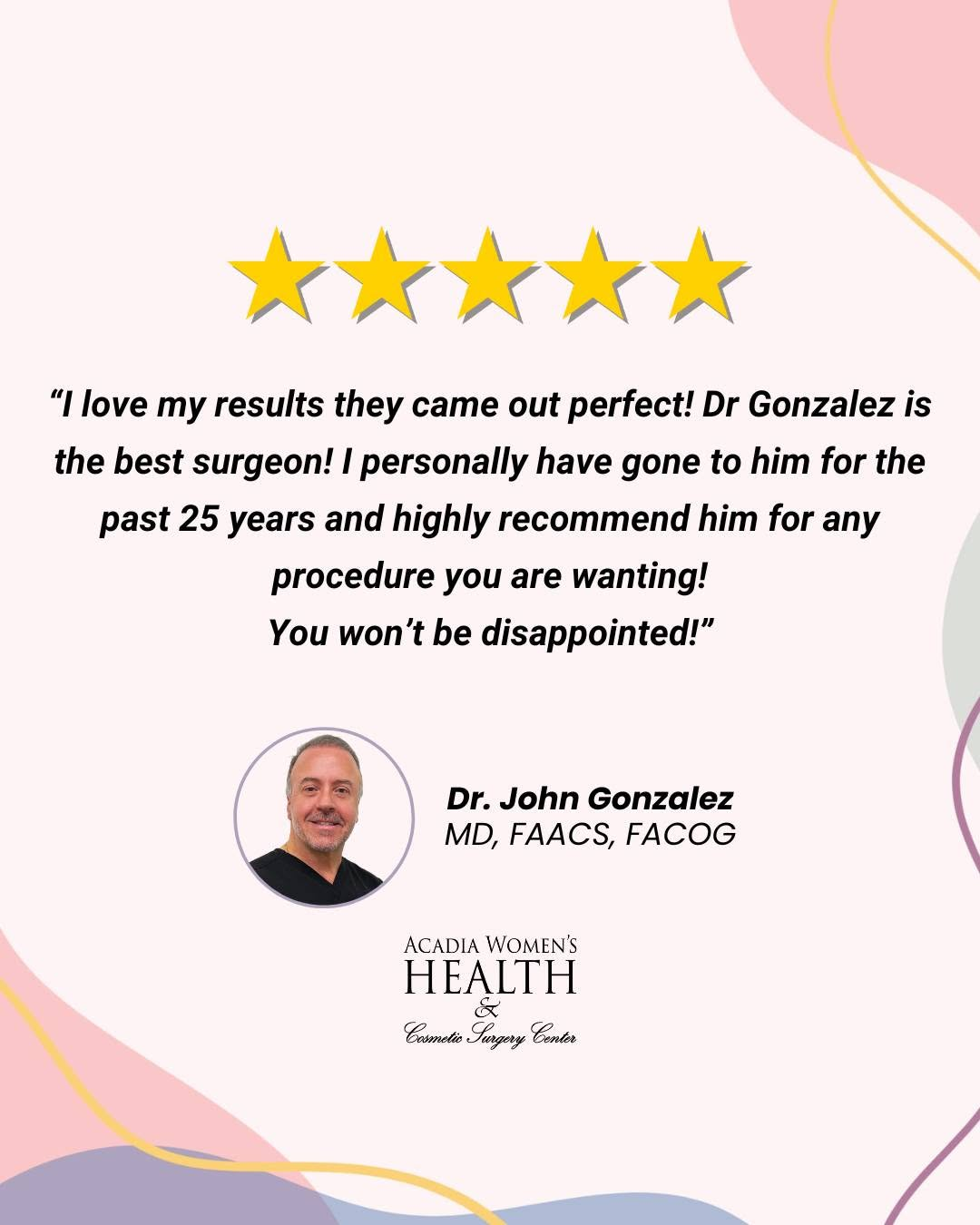
Asma came in expecting a sales pitch and got a straight answer instead, which is what an honest evaluation is supposed to look like.
"Dr Owens did a thorough exam on me and let me know that she recommended a more involved procedure that their surgeons didn't do ( body lift ). I was impressed by her honesty and professionalism"
There is no pass mark to clear here, only an honest look at your health and your timing. If a tummy tuck is right for your body, the evaluation is the thing that gets you to yes. If the timing is not right yet, you will walk out knowing exactly what would change that. Either answer beats another year of wondering.
A good next step is simply looking at real results from women whose starting point resembled yours, then having one honest conversation about your own. When it feels right, you can reach out to our team for a free consultation, or call 337-514-4369. There is no pressure to decide anything that day.
You have spent a long time putting everyone else first, and wanting to feel comfortable in your own body again is reason enough. Acadia Women's Health has been caring for women in Crowley and across Acadiana since 1999, and we understand the body you have and the body you want.
The clearest reasons to hold off are planned major weight loss, a pregnancy you are still hoping for, and current nicotine use. Any health condition that is not yet under control, such as unmanaged diabetes or unstable heart disease, is another. Active infection, significant clotting problems, and extensive scarring from earlier abdominal surgery also require a closer look. Most of these are timing issues rather than permanent answers.
No, but you do need to be at a weight you can hold. Surgeons generally want to see stability for roughly six months to a year, because a body that is still changing will keep changing after surgery. A weight you maintain comfortably beats a lower number you have to fight for.
There is no single universal cutoff, and a higher BMI does not automatically close the door. What matters is your overall health, how steady your weight has been, and whether combining procedures is safe on the same day. Some surgeons will split the work into two shorter surgeries instead, so each one asks less of your body, which is careful planning rather than a rejection.
Yes, once you have been off nicotine long enough for your circulation to recover. Nicotine narrows the small vessels feeding your skin, and that blood supply is exactly what the healing incision depends on. Your surgeon will give you a specific window before and after surgery, and vapes, patches, and gum count.
You can, but most women choose to wait. Pregnancy stretches both the skin and the muscle repair, so a later baby can soften the result you worked for. If another child is a real possibility, it is worth saying so at your consultation so the timing conversation is honest.
Yes, and for many women that repair is the whole point. Physical therapy is usually worth trying first, but when a separation is wide it tends to stay open. The surgeon brings the two muscle bands back toward the midline and stitches them there, which also helps the sense of core support you notice when you stand up straight.
Partly. Stretch marks living on the skin that gets removed, usually below the navel, come out with it, while marks above or to the sides stay. An old C-section scar can often be taken out entirely and replaced by the new lower incision.
Often yes, provided the condition is well controlled and your medical team clears you. Uncontrolled blood sugar slows wound healing, so it gets addressed before a surgical date is set rather than worked around afterward. This is one of the advantages of a practice that also handles women's health, since a lot of that coordination happens under one roof.
Usually not, though it does affect planning. Old incisions can interrupt the blood supply to the skin your surgeon needs to lift and move, and upper abdominal scars matter more than a low C-section scar. Bring the details of any past operation to your consultation so your provider can factor it in.
No. It is contouring surgery that removes loose skin and tightens muscle, and the change shows up in how your clothes fit far more than on the scale. Women who treat it as a finishing step after their own weight work are the ones happiest with the result.
Both can soften what the surgery achieved, since each one stretches skin and muscle that were tightened. A later pregnancy is generally considered safe, and plenty of women have had one, but it may change your contour. Keeping your weight steady afterward is the simplest way to protect the result long term.
Disclaimer: This article is for general educational purposes only and is not medical advice. Reading it does not create a physician-patient relationship. Every patient is different, individual results vary, and no outcome is guaranteed. Talk with a qualified physician about your specific situation before making any treatment decision.

Written by
Cosmetic Surgeon, Board-Certified Urogynecologist
Fellow of the American Academy of Cosmetic Surgeons; Fellow of the American College of Obstetricians and Gynecologists. Medical Degree: University of Miami School of Medicine; Residency: Orlando Regional Healthcare System as Chief Resident.
Our board-certified team offers personalized, judgment-free consultations to help you decide what's right for you.
RECENT POST
BROWSE BY CATEGORY
VISIT US
527 Odd Fellows Road STE B
Crowley, LA 70526
(337) 514-4369
Mon – Thu 8:00 – 5:00
Friday 8:00 – 12:00