Acadia Women's Health
October 3, 2026
min read

The hardest part of a tummy tuck to picture in advance isn't the surgery, it's the first week afterward. For most women weighing the decision, the question underneath everything else is the same one: how bad is that first week, really? That's a fair thing to want a straight answer about, and most recovery timelines online don't give one. They read as a list of restrictions rather than a description of how the weeks actually feel.
Surgeons worldwide performed more than a million tummy tucks in 2024, according to the International Society of Aesthetic Plastic Surgery. At that volume, the healing sequence is unusually well documented. The weeks tend to follow a recognizable pattern, which is what makes a week-by-week account possible in the first place.
We're Acadia Women's Health, a women's practice in Crowley, Louisiana, caring for women across Acadiana. Recovery is something we plan with you before surgery day rather than after it, because preparation is most of what makes the first week manageable. Below is the honest week-by-week version, from the days before surgery through the months your shape is still settling.
Most of what makes recovery feel manageable is decided before you ever get to surgery day. The women who come through it calmest are usually the ones who set their life up while they still felt good.
It starts at the consultation, which is free here and is a one-on-one visit with one of our providers. Part of that visit is walking through your recovery timeline out loud, so you know what each stage should look like for your plan.
That conversation is where the honest logistics get settled. How much loose skin is coming off, whether your abdominal muscles need repair, and what kind of anesthesia fits the plan all change how the first two weeks feel.
Anesthesia is a good example. At Acadia, we use an anesthetic given by a certified registered nurse anesthetist, so you sleep through the surgery.
Our two co-founders, Dr. John Gonzalez and Dr. Michelle Owens, have been caring for women in Crowley since 1999. They'd rather you know exactly what's coming than be pleasantly surprised.
That's why your aftercare instructions come home with you on paper, in your pre-op packet. You can read them at the kitchen table at nine at night, which is usually when the questions arrive.
Practical setup matters just as much. Line up an adult to drive you home and stay overnight, then plan real help for the first few days with bathing, meals, medications, laundry, and children.
Don't plan on lifting a small child at first. That single restriction reshapes more households than any other, so arrange hands-on help before you need it.
Build your resting spot before surgery too. A recliner or a bed with a good stack of pillows works well, with water, medications, a phone charger, loose clothing, and easy food within arm's reach.
Then be generous with your calendar. Many women return to a desk job in about two weeks, while a physically demanding job often needs four to six weeks. Book the time off you might need rather than the minimum you hope for.
Between now and surgery you can handle your forms and manage appointments through the patient portal, the secure online account where your records live.
The first week is the most demanding stretch, and knowing that in advance makes it much easier to sit through. Expect soreness, a tight pulling sensation across your middle, swelling, bruising, skin that feels numb, and a level of tiredness that surprises most women.
The tightness is usually the part nobody warns you about. If your abdominal muscles were repaired, those internal stitches act something like a corset, which is why standing up straight isn't on the menu yet.
So you'll walk bent slightly forward for the first week or two, and rest with your upper body raised and your knees supported. It looks awkward and it feels stranger than it looks. It also takes tension off the incision while it heals, which is the whole point.
Walking itself starts almost immediately, often the day of or the day after surgery. Short trips around the house, repeated through the day, keep your circulation moving and lower the risk of a blood clot.
If your surgery was done under a local numbing solution, the area stays numb for several hours afterward, which softens that first evening. Pain is otherwise managed with what your surgeon prescribes, and most women find it steps down noticeably after the first few days.
You might be thinking, "I don't know if I can handle a drain." Most women feel that way beforehand, and it's a fair thing to wonder about.
If you go home with closed-suction drains, the daily routine is short and it's the same every time:
That written record isn't busywork. Your surgeon decides when the drains come out based on how much fluid is still collecting, so those numbers you write down are what make the call.
The rest of the week is gentler than it sounds. Keep your dressings and your belly button clean and dry, and follow the showering instructions you were given. Your compression garment or binder stays on more or less continuously for the first two weeks.
Call the office rather than waiting it out if a drain stops flowing, if output suddenly turns bloody, or if you notice a fever, spreading redness, or swelling that climbs quickly. Those calls are ordinary and welcome, and an early one is far easier for everyone than a late one.
Week two is usually where the corner turns. Drains often come out around the end of the first week or early in the second once the fluid slows down, and losing them makes everything feel closer to normal.
Your posture straightens over the course of week two, a little more each day. Walking distance and stamina climb with it, and most women start handling light household things on their own again.
The incision at this stage is still pink, firm, tight, and numb to the touch, with the small drain sites closing up. Side sleeping tends to get comfortable somewhere around weeks three and four, which most women count as a genuine milestone.
Driving comes back once you're completely off prescription pain medicine, alert, and able to slam the brake without hesitating. That usually lands in the same stretch, but the test is how you feel, not what day it is.
Work depends entirely on what your day asks of you. A desk or remote job is often workable around two weeks, while a job with lifting or hours on your feet generally needs four to six weeks or more.
Swelling is still very much present through week four, and bruising should be fading through green and yellow. Numbness is the symptom that startles women most at this point, so it helps to know how common it is. In a 2026 study that mapped it out, more than 9 in 10 patients still had changed sensation a month after surgery.
What still waits is lifting, forceful bending, pushing, pulling, and real exercise. Nothing over about 10 pounds, which quietly rules out a full laundry basket and a small child.
Your first follow-up visits happen in this window at our Crowley office. At Acadia Women's Health we look at how you're actually healing and clear you step by step, rather than reading you a calendar.
Heather was four weeks out from a tummy tuck with muscle repair when she wrote this.
"I am four weeks postop from a tummy tuck and muscle repair with Dr. Gonzalez and it has gone above and beyond anything I could have ever imagined. The recovery has been amazing and honestly so easy. I feel so great, and I don't even think I was mentally prepared for what I would look like, because I could not imagine it. My scar is pretty perfect, if scars can be beautiful it is and it healed so quickly."

Weeks five through eight are a step-by-step return to activity, not a green light. The goal through this stretch is to rebuild without pulling on a repair that's still maturing underneath.
Once the incision is closed, swelling has leveled off, and the surgeon agrees, longer walks and low-resistance stationary cycling are usually reasonable around weeks four to six. Most everyday activities are back by about week four.
More strenuous exercise generally opens up around week six with medical approval. A sensible way back in is to start at roughly half your old weight and repetitions, then add more only if the next day brings no extra soreness or swelling.
The high-impact things wait longer. Running, jumping, interval training, heavy lifting, and contact sports often stay off the list past week eight, frequently closer to 10 or 12 weeks when the abdominal muscles are repaired.
Core work is last for a straightforward reason. Crunches, planks, and twisting load the healing muscle wall and the incision more directly than almost anything else, so they get delayed the longest.
Activity
Typical earliest window
Why it waits
Short walks around the house
Day 1
Keeps circulation moving and lowers clot risk
Desk or remote work
About 2 weeks
Sitting is fine once prescription pain medicine is done
Driving
Off prescription pain medicine, often 1-2 weeks
You need to brake hard without hesitating
Physically demanding work
4-6 weeks or more
Lifting and long hours standing strain the incision
Lifting over about 10 pounds
4-6 weeks
Includes laundry baskets and small children
Longer walks, low-resistance cycling
4-6 weeks
Builds stamina without loading the repair
Running, interval training, impact sport
After 8 weeks, often 10-12
Repeated impact pulls on the closure
Crunches, planks, twisting
Last, once cleared
They load the repaired muscle wall directly
Ordinary life fills back in through this window too. Sex is reasonable once wounds are healed and movement is comfortable with no pressure on the abdomen. The compression garment usually tapers from all-day wear to nights only before it stops altogether.
If something pulls, hurts, drains, or swells noticeably after an activity, that's just information. Stop that activity and call the surgical team. Chest pain, breathlessness, or one-sided leg swelling are emergencies rather than callbacks.
Backing off for a few days after a flare isn't a setback. It's how most women end up happy with the result. Healing takes the time it takes, and a few slow weeks matter more here than how many workouts you get through.
At two months your stomach is already much flatter, and it's also still changing. Swelling and bruising can take up to three months to fully resolve, and the contour is usually close to its final shape around that same three-month mark.
Tightness, pulling, and numb or oddly sensitive patches can linger for weeks or months longer than the soreness does. Sensation generally keeps improving over the months that follow, which is worth remembering on a day when your skin still feels like someone else's.
One thing that worries women more than it should is the upper belly. A full or slightly bulging upper abdomen at this stage is usually leftover fluid and changing tissue tension. That's especially true if separated muscles or the connective tissue underneath them were repaired, and it isn't a sign the surgery didn't work.
The kind that does need checking feels different. A bulge that's enlarging, painful, lopsided, red, hot, or feels like fluid under the skin should be examined, and that's a call worth making the same day.
Your scar has its own slower clock. At two months it may still be red, firm, or slightly raised, and it'll gradually flatten and lighten over a year or more.
Once it's fully healed, silicone gel or sheets can help it soften and flatten. Sun protection matters more than most women expect, because ultraviolet light can permanently darken a young scar. Use at least SPF 30 and cover the area with clothing outdoors.
We talk through scar care with you before surgery and check in on how it's healing at your visits. Acadia Women's Health sees women from across Acadiana at every stage of this, and comparing notes at a follow-up beats comparing yourself to a stranger's photo online.
Two honest answers to the questions that come up most here. A tummy tuck is body contouring rather than a weight-loss operation, so expect the scale to move only slightly and plan on holding a steady weight to protect your shape.
Recovery also runs longer for some women than others. More tissue removed, muscle repair, or a physically demanding job all mean more healing to do, which is a reason to be patient with your timeline rather than worried about it.
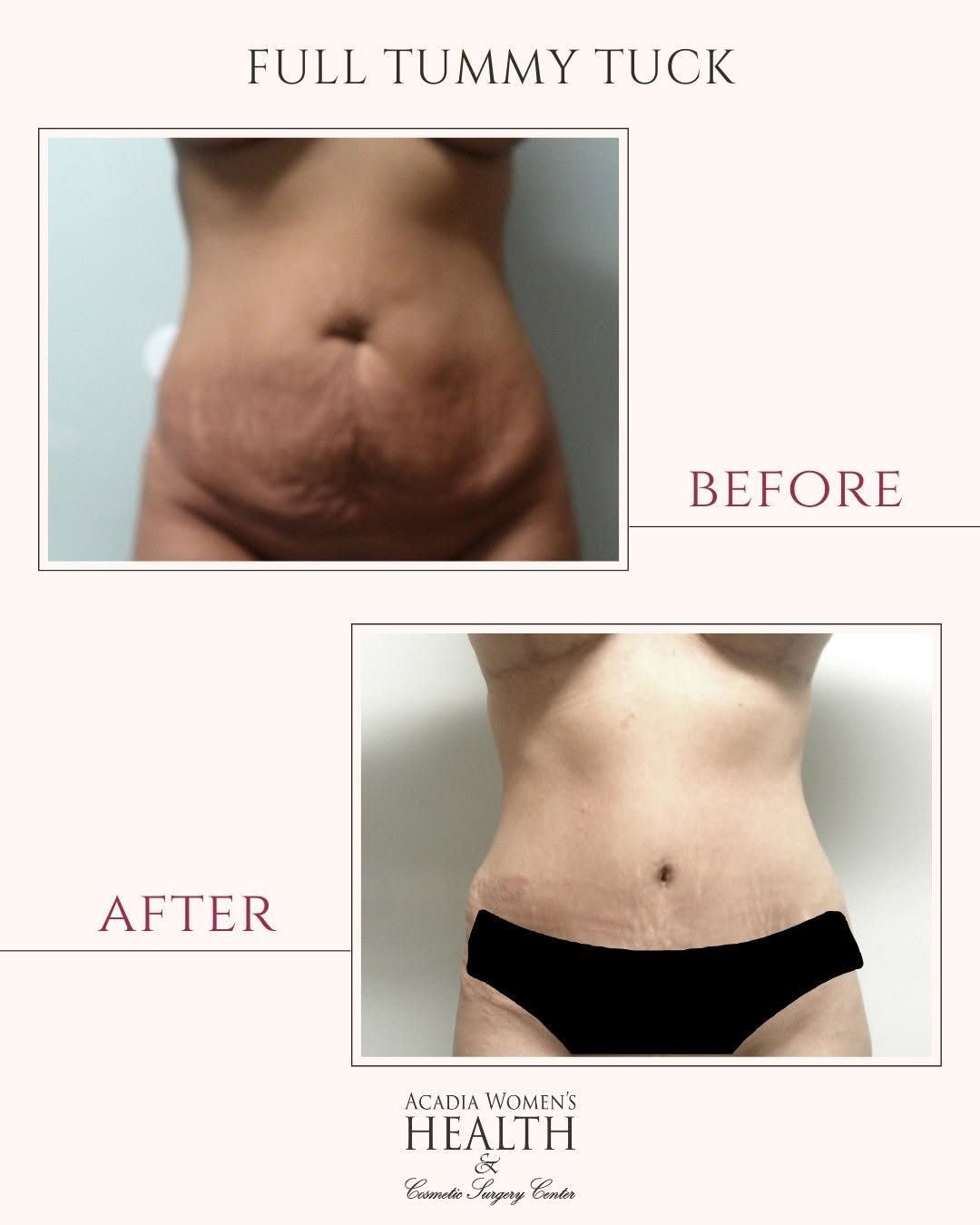
When you're ready to see where all of this is heading, you can view real tummy tuck results in our gallery.
Knowing the difference between expected and concerning takes most of the anxiety out of recovery. The great majority of what you feel in the early weeks is your body doing exactly what it's supposed to do.
Tenderness along the incision, bruising, swelling, tiredness, numbness, and a small amount of drainage all belong on the normal list. Mild redness, itching, and puffiness right at the suture line are common too, and the whole pattern should trend gradually toward better.
Call the office promptly, rather than waiting for your next visit, if the direction reverses. Any of these deserve a same-day conversation:
A new soft, squishy pocket of fluid or a swelling that grows quickly also warrants a look. Usually it's a seroma, a small collection of fluid the body often reabsorbs on its own, and it's very manageable when caught early.
Two situations skip the phone call and go straight to emergency care. New swelling, redness, warmth, or tenderness in one leg can signal a clot. Chest pain, sudden shortness of breath, fainting, severe trouble breathing, or coughing up blood needs emergency services immediately.
None of that list is likely, and reading it isn't a warning about how this usually goes. It's the same short list every surgical patient gets, and it exists so that a small thing stays a small thing.
This is also where a phone number helps more than a list does. Cosmetic surgery patients at Acadia Women's Health get their surgeon's personal cell number. A worry at nine at night gets a real answer from someone who knows your case, instead of a sleepless wait until morning.
Shawntel had a tummy tuck at our Crowley office and found the checking-in went both ways.
"Dr Owens and her Team took such good care of me and called me and checked on me and FaceTime me to see how everything looks and how to take my shower. I love that there so hands on and available through her cell phone and there so Gentle with you and answer all your questions."
So, how bad is that first week, really? Demanding, honestly, and shorter than you're picturing. A tummy tuck recovery asks for real help and real rest up front. Then it gives most of your normal life back inside a month, while the finer changes keep settling quietly for the rest of the year.
A good next step costs nothing and commits you to nothing. Looking at real before-and-after results helps you picture where this ends up, and you can reach out to our team for a free consultation and straight answers about your own timeline.
Acadia Women's Health is here in Crowley, and we'd rather help you plan this well than rush you into it. When you're ready, call us at 337-785-2006. If you're still thinking it over, that's a perfectly good place to be.
Plan on about two to four weeks to get most of your daily life back. Harder activity generally opens up around six to eight weeks, swelling keeps settling for roughly three months, and the scar matures over a year. Because the answer depends on how much work your abdomen needs, mapping your own timeline is part of what the free consultation is for.
Drains typically come out once the fluid draining each day drops low enough. That's often around the end of the first week or during the second. The decision is based on your recorded output rather than a set date, so some women keep them a little longer, and that isn't a sign anything is wrong.
Many surgeons allow a short, gentle shower a day or two after surgery, and your own instructions will confirm the timing. Baths, pools, and hot tubs wait until the incisions are fully closed, usually around three weeks. Let clean water run over the area instead of scrubbing it.
Expect to walk slightly bent forward for the first week or two, then straighten gradually through week two. Standing tall too early puts tension on the incision, so the stoop is doing a job. Most women are comfortably upright by the end of the second week.
Most women wear the garment or binder almost continuously for the first two weeks, then as much as possible for about another month. It supports healing tissue and helps keep swelling down. Your surgeon will tell you when to taper to nights only and when to stop.
You can drive once you're completely off prescription pain medication, fully alert, and able to brake hard without pain or hesitation. For most women that falls somewhere in the first two weeks. Never drive while you're still taking prescription pain medicine, even for a short errand.
A desk or remote job is often manageable around two weeks. Work that involves lifting, bending, or long hours on your feet usually needs four to six weeks or more. Schedule the longer estimate and let yourself be pleasantly surprised.
Lifting is capped near 10 pounds for roughly the first four to six weeks, which includes picking up a baby or toddler. This is the restriction most moms find hardest, so line up hands-on help before surgery. Our surgeons clear you for heavier lifting based on how your repair is healing.
Core work is saved for last, usually beyond the eight-week mark and only with your surgeon's clearance. Crunches, planks, and twisting pull directly on the repaired muscle wall. Rebuilding your core last protects the flat result you had the surgery for.
Swelling is heaviest in the first week or two and eases noticeably through the first month. The last of it can take up to three months to clear, and your contour is usually close to final around that point. Swelling that suddenly increases or is much worse on one side is worth a call.
Numbness across the lower abdomen is very common and can last weeks to months as the nerves gradually wake back up. Nearly all women still notice some altered sensation at one month, so it's expected rather than alarming. If a numb patch still bothers you months later, bring it to a follow-up visit and our team will take a look.
Disclaimer: This article is for general educational purposes only and is not medical advice. Reading it does not create a physician-patient relationship. Every patient is different, individual results vary, and no outcome is guaranteed. Talk with a qualified physician about your specific situation before making any treatment decision.

Written by
Cosmetic Surgeon, Board-Certified Urogynecologist
Fellow of the American Academy of Cosmetic Surgeons; Fellow of the American College of Obstetricians and Gynecologists. Medical Degree: University of Miami School of Medicine; Residency: Orlando Regional Healthcare System as Chief Resident.
Our board-certified team offers personalized, judgment-free consultations to help you decide what's right for you.
RECENT POST
BROWSE BY CATEGORY
VISIT US
527 Odd Fellows Road STE B
Crowley, LA 70526
(337) 514-4369
Mon – Thu 8:00 – 5:00
Friday 8:00 – 12:00
%20(SM).png)
(sm).png)
(SM).png)