Acadia Women's Health
October 1, 2026
min read
A tummy tuck is real surgery, and the risk list is where a lot of research quietly stalls. Reading through blood clots, infection, and wound healing problems for the first time is enough to stop anyone, even someone who has already made peace with the scar and counted the weeks off work. That is a fair reaction, and a question that seriously deserves a real answer rather than reassurance.
A national safety database reviewed by the American Society of Plastic Surgeons tracked nearly 25,000 tummy tucks, and serious problems turned up in 3.1 percent of women who had the surgery on its own. That is the number worth holding on to while you read the rest.
At Acadia Women's Health in Crowley, Louisiana, we would rather you hear the risks from us than find them at midnight on a message board. This article covers what can go wrong, which health factors move your odds, how to prepare, and the symptoms that mean call now.
Most of what happens after a tummy tuck is healing, not a complication. Knowing which is which is what keeps you calm at week two, so here is the honest map of both.
For the first several days your abdomen feels tight, sore, and heavy. That tightness is the repair doing its job. Your surgeon has pulled the muscle wall back together and removed loose skin, so the area is under real tension while it knits.
Swelling and bruising fade over weeks, not days. Most women are back at desk work around two to four weeks, and off strenuous activity for four to six.
Numbness surprises people more than pain does. The skin between your belly button and the incision often feels muffled for a while, because small sensory nerves were interrupted. For most women that feeling returns over several months as the nerves settle.
The most common thing your surgeon watches for is a seroma, a pocket of clear fluid that gathers in the space under the skin. Reported rates range from 5 percent to 43 percent across studies, largely because surgeons count them differently. Small ones are simply watched, and larger ones are drawn off with a needle in the office in a few minutes.
A hematoma is the same idea with blood instead of clear fluid, reported in roughly 3 to 7 percent of cases. A small one reabsorbs on its own. A large one gets drained, and handled promptly it usually leaves no mark on your final result.
A tummy tuck lifts a large flap of skin and fat, and that flap has to keep its blood supply while it heals into its new position. When circulation at the edges is poor, healing slows. The incision can separate at a spot, or a small area of skin or fat can fail to survive.
Infection and skin loss are both reported in the low single digits. Each usually responds to antibiotics, dressing changes, and time. Slower healing is frustrating in the moment, though it rarely changes where you end up a year later.
Not every disappointment is a medical complication. Scars can widen or thicken. One hip can settle differently than the other, a little looseness can return, or the belly button can heal in a shape you did not picture.
These are the issues most likely to prompt a small revision later, and also the ones a careful plan does the most to prevent. Time spent talking honestly about your skin and your goals before surgery pays off well here.
Anesthesia carries its own small set of risks, including reactions to medication, nausea, and breathing or heart problems. Modern monitoring has made these uncommon in healthy patients who are screened properly beforehand.
The one that draws the most worry is a clot that forms in a leg vein and can travel to the lungs. It is rare, and it is the reason your team will have you up walking so soon after surgery.
In that national database, the serious problems that did occur were mostly bleeding under the skin, infection, and suspected or confirmed clots. Nearly all of them are treatable, and nearly all of them announce themselves with symptoms you can learn to spot.
This is the part that matters most, and it does not get said often enough. The risks of abdominoplasty are not one fixed number that applies to everyone. Your health and the surgery you choose move that number more than anything else, which means a lot of it sits in your hands.
Weight matters, but steadiness matters more than size. A higher BMI is linked to more wound trouble and more clot risk, and it was one of the factors that raised complication rates in that same national database.
That does not close the door. What surgeons look for is a weight that has held steady, and Mayo Clinic suggests roughly 6 to 12 months of stability. Settled tissue heals more predictably, and the result lasts longer.
Nicotine is the single biggest factor you control. Smoking narrows blood vessels and thickens the blood, exactly the wrong combination for a flap that needs circulation. In one series of 132 tummy tucks, wound healing problems occurred in 47.9 percent of smokers compared with 14.8 percent of nonsmokers.
Quitting before surgery moves you straight into the safer group, and it is the one risk factor here you can change on your own.
Diabetes deserves an honest word too. A 2025 review of 15 studies covering 79,724 patients found more overall complications and more than double the wound complications among patients with diabetes. Well-controlled blood sugar is a very different conversation than uncontrolled blood sugar.
Prior abdominal surgery matters for a related reason. Old scars change where the blood supply runs, which makes the tissue less predictable to work with.
Then there is the plan itself. Plenty of women have a tummy tuck and liposuction at one time and heal without trouble, and one recovery instead of two is a real benefit. Adding procedures into one (like a mommy makeover) also adds time under anesthesia and more surface area to heal, so the risk climbs in steps.
None of that is an argument against combining. It is an argument for a surgeon who reads your specific health honestly and says so, including when two calmer sessions would be the safer route.
That honest read is what the first visit is for. At Acadia Women's Health, your free consultation is a one-on-one visit with one of our providers, and you will get a straight answer about what is realistic for your body. When you are ready, you can talk it through with no pressure to decide anything that day.

Preparation buys you the most safety for the least effort. Nearly everything that follows happens weeks before you see an operating room.
Start with a complete history. Your surgeon needs every illness, prior operation, medication, supplement, and allergy, plus any nicotine use and your plans for pregnancy. Nothing on that list is embarrassing, and leaving something off is the only version that causes trouble.
Medications come next, and this one has a firm rule attached. Never stop a prescribed blood thinner on your own. Warfarin, the newer oral anticoagulants, aspirin, and other antiplatelet drugs all need a plan made with the doctor who prescribed them.
Common supplements matter too. Ginkgo, vitamin E, high-dose fish oil, and St. John's wort can all increase bleeding or interfere with anesthesia, so bring the actual bottles if that is easier.
Nicotine has a timeline of its own. Most surgeons ask for at least four weeks off all nicotine before surgery and four weeks after, and that includes vapes, patches, and gum. Timing matters the same way for a planned pregnancy or a big weight loss, since waiting protects the result you get.
Then there is the practical layer nobody warns you about. Arrange a driver, an adult who stays the first night, and real help with children, meals, and laundry for the first week to ten days. Women who set this up in advance consistently have an easier time.
Tori found the questions got answered before surgery, not after.
"My surgeon was exceptional from the initial appointment, pre-op, through the surgery, and post op. He has a wonderful bedside manner and makes you feel extremely comfortable. He walked through all of my questions and provided detailed explanations for any concerns and reassured my expectations."
Which brings up the questions worth asking out loud at your visit:
You are allowed to ask all of it. Our practice was built by Dr. John Gonzalez and Dr. Michelle Owens. Both are board certified in obstetrics and gynecology by the American Board of Obstetrics and Gynecology, an ABMS member board, and both are Fellows of the American Academy of Cosmetic Surgery.
Dr. Gonzalez has more than 25 years of surgical experience. He was among the first physicians in Acadiana to perform abdominoplasty in the office under local anesthesia.
Your facility and your anesthesia deserve the same scrutiny. Cosmetic procedures here are done in three fully accredited in-office surgical suites, where more than 5,000 cosmetic surgeries have been performed.
That setting held up well in the national data. Complication rates were lower for tummy tucks done in an office-based surgical suite than in a hospital or surgery center. The researchers noted that patients with serious illnesses are often sent to hospitals, which likely explains part of that gap.
Some procedures use tumescent anesthesia, a numbing solution that keeps you awake but comfortable with the treated area numbed. Others use anesthesia given by a certified registered nurse anesthetist, which lets you sleep through the surgery. Which one fits you is a decision made with your surgeon, based on the operation and your health.
Recovery rules feel arbitrary until you know what each one prevents. Almost every restriction traces back to one of three things: clots, fluid, or tension on the repair.
Walking comes first, and it starts almost immediately. Most women are up and moving slowly, with help, the day after surgery. Movement keeps blood from pooling in the leg veins, which is the mechanism behind most clots.
That effect is well studied. Researchers pooled 74 trials covering more than 9,000 patients and found that recovery plans built around getting people moving early cut complications by about 29 percent.
Drains and compression handle the fluid side. If you go home with small drains, they are emptied and measured several times a day, and they usually come out within about three to fourteen days once the output slows.
Your binder or compression garment does quieter work, supporting the repair and limiting the space where fluid can gather. Neither one is glamorous, and both are doing real work.
Blood thinning medication is not automatic for everyone, and that is deliberate. Preventing clots has to be weighed against the risk of bleeding under the skin, so your team decides based on your personal history rather than one blanket rule.
The activity restrictions follow the tension logic. No heavy lifting, pushing, pulling, or strenuous exercise for roughly four to six weeks. A toddler and a full laundry basket both count as heavy lifting.
Driving waits until you are off pain medication that makes you drowsy and can brake hard without hesitating. Most women need real help at home for the first seven to ten days.
Follow-up is the last safety net, and it is deliberately front-loaded. Expect to be seen within the first day or two, again at about a week, then at a month and beyond. Between those visits, the patient portal is where you message the team, manage appointments, and pull up your records or forms.
Your written aftercare instructions come home with you on paper, in your pre-op packet, so you are not hunting for them at 10pm. The problems worth catching tend to declare themselves early, and that sheet tells you exactly what to look for.
This is the part women ask about most: how do you tell normal healing from a real problem when you have never done this before? The honest answer is that healing improves a little each day, while trouble either gets worse instead of better or arrives suddenly.
Call your surgeon the same day, without waiting for your next appointment, if you notice:
Call 911 right away, before calling the office, for any of these:
That last one deserves its own note. A painful, swollen leg on one side can mean a clot. Do not massage it and do not drive yourself.
Reaching us should never be the hard part. Cosmetic surgery patients here are given their surgeon's personal cell number, and the office line is 337-785-2006. Nobody at Acadia Women's Health has ever been annoyed by a patient who called about something that turned out to be nothing.
Essence said she was told what to expect up front, and could reach her care team afterward.
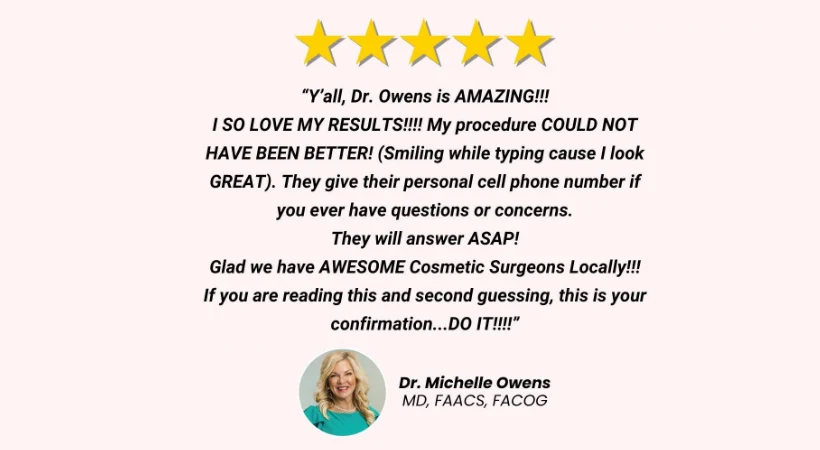
"Gave a thorough explanation of everything to expect and issues that may occur. My surgeon also gives his personal cell number to message when I would randomly think of anything day or night and answered back quickly."
The risk list is where a lot of research stalls. Now you know what is actually on it. A tummy tuck carries real risks, most of them uncommon and treatable, and a meaningful share of them shaped by choices you make long before surgery day.
Reading through the risks before a decision this personal is the right instinct. Knowing what to watch for, and what to ask, is a real part of a safer surgery. When you want a real answer about your own body, reach out to our team and bring every question on your list.
The team at Acadia Women's Health has cared for women in Crowley and across Acadiana for more than 25 years. The part we take most seriously is telling you the truth about your own risk, so you are deciding from what you know instead of what you are afraid of. If you would rather start with a phone call, we are at 337-785-2006.
For a healthy woman at a stable weight, a tummy tuck is a well-studied operation with a low rate of serious problems. In a national database of nearly 25,000 cases, major complications occurred in about 3 percent of tummy tucks done on their own. That is not zero, which is exactly why screening and preparation matter.
Seroma, a pocket of clear fluid under the skin, is the one surgeons see most often. Reported rates vary a great deal between studies because surgeons count them differently. Small ones are watched, and larger ones are drained in the office in a few minutes.
Clots are among the least common complications but get the most attention because they are the most serious. Risk is lowest for a tummy tuck done alone and rises when other procedures are added to the same surgery. Early walking and an individual clot-risk assessment are the main protections.
Numbness across the lower abdomen is normal and usually improves over several months as small nerves recover. Some women keep a patch of reduced sensation near the incision, and most stop noticing it. Lasting nerve symptoms affect only a small minority of patients.
Yes, more than almost any other factor you control. Nicotine narrows blood vessels and slows healing exactly where a tummy tuck needs good circulation. Studies show a large jump in wound problems among smokers, which is why most surgeons ask for at least four weeks off all nicotine before and after surgery.
A higher BMI raises the risk of wound trouble and clots, but it does not automatically rule you out. What surgeons look at is whether your weight has been steady for several months and how your overall health looks. A free consultation is the fastest way to get an honest read on your situation.
Controlled diabetes usually does not prevent surgery, though it does shape how your team plans anesthesia, healing, and follow-up. Uncontrolled blood sugar is a reason to wait, because it meaningfully raises wound complications. Bringing recent labs to your consultation makes that conversation much faster.
Slightly, yes. Major complications run about 3.1 percent for a tummy tuck alone and about 3.8 percent when liposuction is added, climbing further with larger combinations. Many women still combine safely, and having it done in one accredited surgical suite by a team that knows your history is part of what keeps that number low.
Call the same day for worsening pain, rapidly increasing or lopsided swelling, spreading redness, fever, thick or foul-smelling drainage, or an incision starting to open. Call 911 for chest pain, shortness of breath, or a painful swollen leg. Our cosmetic surgery patients also have their surgeon's personal cell number, so reaching someone is straightforward.
A pregnancy after a tummy tuck is generally safe, but it can stretch the repaired muscle and skin and undo part of your result. For that reason most surgeons suggest waiting until you are done having children. If your plans are uncertain, say so at your consultation so the timing can be talked through.
Disclaimer: This article is for general educational purposes only and is not medical advice. Reading it does not create a physician-patient relationship. Every patient is different, individual results vary, and no outcome is guaranteed. Talk with a qualified physician about your specific situation before making any treatment decision.

Written by
Cosmetic Surgeon, Board-Certified Urogynecologist
Fellow of the American Academy of Cosmetic Surgeons; Fellow of the American College of Obstetricians and Gynecologists. Medical Degree: University of Miami School of Medicine; Residency: Orlando Regional Healthcare System as Chief Resident.
Our board-certified team offers personalized, judgment-free consultations to help you decide what's right for you.
RECENT POST
BROWSE BY CATEGORY
VISIT US
527 Odd Fellows Road STE B
Crowley, LA 70526
(337) 514-4369
Mon – Thu 8:00 – 5:00
Friday 8:00 – 12:00
%20(SM).png)
(sm).png)
(SM).png)