Acadia Women's Health
October 9, 2026
min read

A tummy tuck is not one operation, which is why two women who had the same surgery can end up with very different scars. One may have a line running hip to hip, another one barely wider than a C-section scar. Same procedure name, different techniques underneath it, and that makes it hard to picture your own result or to know which version anyone is describing.
The differences between them are well documented. A 2024 analysis of 55,596 tummy tucks published in the Aesthetic Surgery Journal compared seven techniques and found major complications in about 2 percent of patients overall.
At Acadia Women's Health in Crowley, Louisiana, we help women across Acadiana match the operation to the body they actually have. This guide walks through each type, who each one suits, how recovery differs, and what to weigh before you choose.
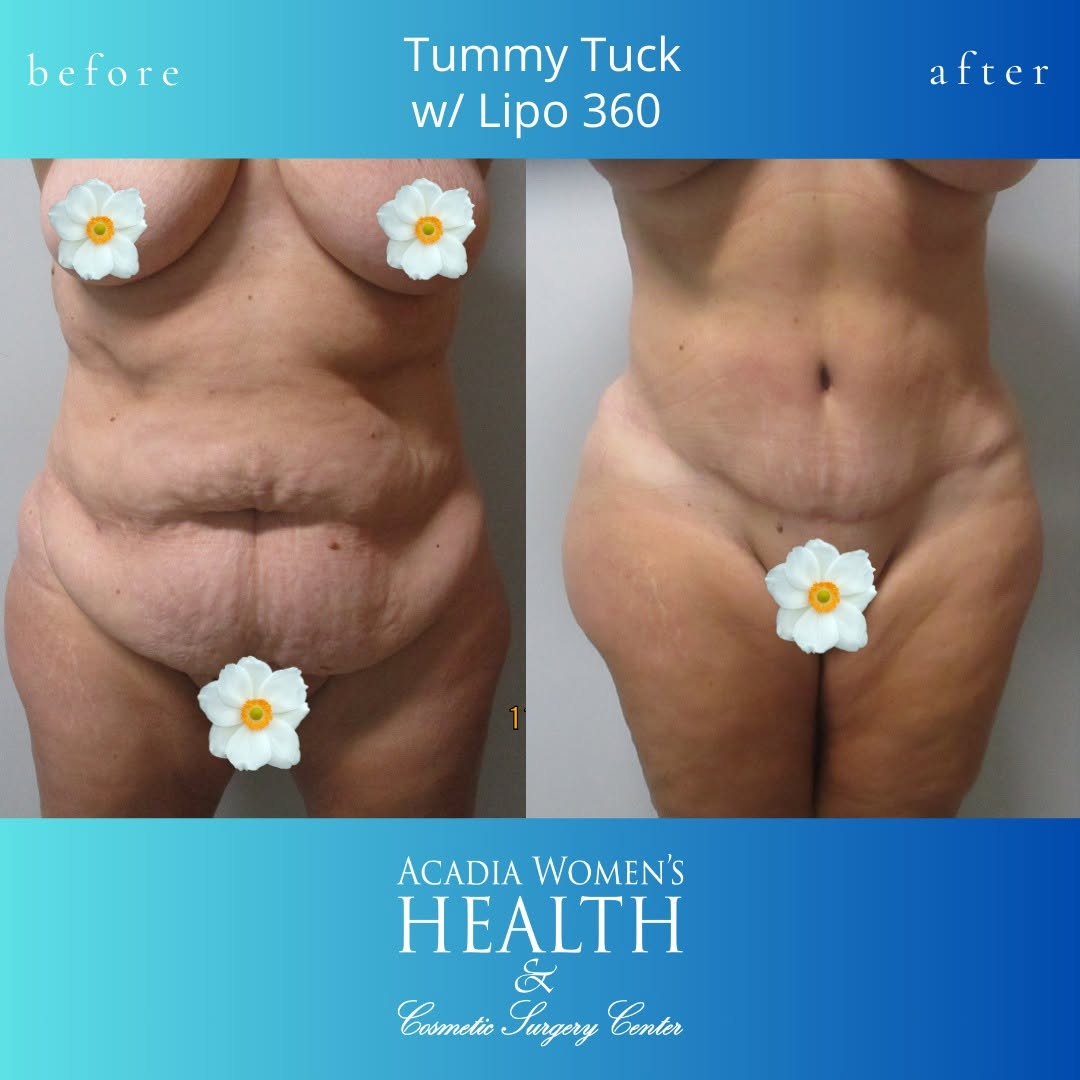
Abdominooplasty, commonly referred to as a “tummy tuck”, works on two layers: the skin and fat on the outside, and the muscle wall underneath. Loose skin and some fat are removed, the remaining skin is smoothed back down, and the muscle wall is tightened when it needs it. It is a shaping operation, not a weight-loss one.
That matters because a stomach that will not flatten usually has three different things going on at once. There is fat, there is skin that lost its stretch, and there is muscle. Each one responds to something different.
The muscle piece surprises most women. During pregnancy, the two vertical muscle bands down the middle of your belly can drift apart, a bit like a zipper coming undone. Doctors call that diastasis recti. Once it happens, no amount of core work pulls those bands back together, which is why the pooch stays even after the weight is gone.
Liposuction is a different tool entirely. It suctions out pockets of fat, and it does that well, but it does not remove loose skin or repair a separated muscle wall. When skin, fat, and muscle are all part of the picture, the two procedures are often done together rather than one instead of the other.
So why is there more than one kind? Because excess skin does not sit in the same place on everyone. On one woman it is a small fold below the navel.
On another it runs above the navel, wraps around the hips, or continues onto the lower back. How far the skin extends decides how long the incision has to be.
The types are best understood by geography, not by a good-better-best ladder. Each one is designed for a different pattern of loose skin, and the smallest operation that fully corrects your pattern is the right one for you. At Acadia Women's Health, our surgeons perform three of these: the mini, the traditional, and the Brazilian tummy tuck.
A mini tummy tuck treats a limited area of the lower abdomen, below the belly button. A small amount of skin and fat comes out, the lower abdominal muscles are tightened, and the incision is about the length of a C-section scar, placed just above the pubic area. The belly button usually stays exactly where it is.
It suits a woman whose weight is steady, whose skin above the navel still has a good tone, and whose concern is a stubborn lower pouch. If loose skin extends above the navel, a mini will not reach it.
The traditional or full tummy tuck removes the skin between the navel and the pubic area, and the incision extends from hip to hip. Both the upper and lower abdominal walls are tightened, so this is the version that fully addresses separated muscles. The navel stays attached to your abdominal wall and comes through a new opening in the smoothed skin.
This is the most common choice after pregnancy or a significant weight loss, when skin has stretched across the whole midsection rather than one small area.
The Brazilian abdominoplasty combines liposuction with removal of excess skin from the lower abdomen. It focuses on contouring rather than maximum skin removal, taking out the excess skin while preserving the tissue underneath. The result leans toward a smoother, more shaped waistline.
It fits moderate loose skin paired with localized fat, which is a common combination and one reason it comes up so often in consultations.
An extended tummy tuck lengthens the horizontal incision out toward the flanks and hips. It is the answer when a standard incision would leave rolls of skin sitting at the sides, often after a large weight loss. More area treated means a longer scar and a longer recovery to plan for.
A fleur-de-lis adds a vertical incision up the midline to the usual horizontal one, creating an upside-down T. It is built for skin that hangs both side to side and top to bottom. That pattern usually follows a large weight loss, and the trade is a more complete correction in exchange for a more visible scar.
A circumferential procedure, sometimes called a body lift, carries the excision all the way around the torso to treat the abdomen, sides, waist, and lower back together. It is the largest of these operations and is reserved for skin that wraps the whole trunk.
Type
Area treated
Scar
Belly button repositioned
Mini
Lower abdomen only
Short, C-section length
Usually no
Traditional (full)
Upper and lower abdomen
Hip to hip
Yes
Brazilian
Lower abdomen with liposuction
Low, lower abdomen
Usually no
Extended
Abdomen plus flanks and hips
Longer, wraps toward sides
Yes
Fleur-de-lis
Abdomen side to side and up the midline
Horizontal plus vertical
Yes
Circumferential
Abdomen, waist, and lower back
Around the torso
Yes
Two notes worth carrying into a consultation. Muscle repair is not automatic with any label; it is added when your abdominal wall needs it, and that is an anatomy question, not a package question. And liposuction can be paired with most of these to refine the flanks or the upper abdomen once the skin is addressed.

Start with a question you can answer at home in front of a mirror. Bend forward slightly and look at where the loose skin gathers. If it collects only below your navel, a smaller operation may reach it. If it folds above the navel as well, or continues around your sides, it will not.
There is a second thing to feel for. Press your fingers into the middle of your belly and lift your head as if doing a small crunch. If you feel a soft gap between two firm bands, that is likely the muscle separation, and it usually points toward a full repair rather than a mini.
Weight stability matters more than any specific number on the scale. Skin that is removed while your weight is still moving can loosen again, so surgeons look for a weight that has held steady rather than one still moving. The same logic applies to future pregnancies: carrying another baby can stretch the repair, so this surgery gives its longest-lasting result once your family is complete.
Your health history shapes the plan too. Smoking, uncontrolled diabetes, and prior abdominal scars all affect how tissue heals, and they change what is safe to do in a single operation. None of that is a closed door. It is information your surgeon needs in order to design something that works for your body.
Bethani had done everything on her own before surgery, and she still had skin that would not go anywhere.
"After having 3 children all delivered by c sections, loosing 100lbs on my own and dedicated to the gym with a clean diet I was still left with an excessive amount of skin on my abdomen. From the consultation to the day of surgery and every follow up appointment I have felt comfortable and at ease with no questions unanswered."
This is the part a website cannot do for you. A consultation at Acadia Women's Health is free, and it is a one-on-one visit with one of our providers. They will examine your abdomen, talk through what each option would and would not change, and tell you honestly which technique fits.
Between visits, you can message the team, manage appointments, and find your records or forms through the patient portal, our secure online system.
Recovery tracks how much tissue was moved, not what the operation is called. A mini generally asks the least of you, a traditional sits in the middle, and extended or fleur-de-lis procedures ask the most. Knowing which one you are having lets you plan the right amount of help at home.
Anesthesia is part of that picture. Some procedures are done under tumescent anesthesia, a local numbing solution that keeps you awake but comfortable while the area being treated is numbed. Others call for anesthesia given by a certified registered nurse anesthetist, which lets you sleep through the surgery.
Our surgeons choose based on the extent of the operation and on you. All of it happens in our three accredited in-office surgical suites, where more than 5,000 cosmetic surgeries have been performed.
Most women take between two and four weeks away from work. A desk job after a mini can sometimes start at the earlier end of that. An extended or fleur-de-lis procedure, paired with physical work, often needs four to six weeks.
Numbers help here. In a 360-patient study reported by the American Society of Plastic Surgeons, average time away from work was about 16 days after a tummy tuck, compared with about six days after liposuction alone. Driving usually waits one to two weeks, and only once you are off pain medication that makes you drowsy.
Milestone
Mini
Traditional
Extended or fleur-de-lis
Desk work
About 2 weeks
About 2-4 weeks
About 4-6 weeks
Driving
About 1-2 weeks
About 1-2 weeks
About 2 weeks
Heavy lifting
About 6 weeks
About 6 weeks
About 6 weeks or more
Full activity and sports
About 6 weeks
About 8 weeks
About 8-12 weeks
You will walk slightly bent forward for the first several days, and that is intentional, because it keeps tension off the repair. A compression garment goes on early and stays on for several weeks to help swelling settle and the skin lie flat. Swelling comes down gradually, and your final shape keeps refining for months after you feel like yourself again.
Scars get attention early, and they should. We talk through scar care before surgery and check in with you as you heal, so you know what is normal at each stage rather than guessing at it.
Every tummy tuck carries the risks that come with surgery. Those include a small pocket of fluid the body reabsorbs, bruising under the skin, slower wound healing, changes in sensation, and a permanent scar.
The pattern is worth understanding rather than fearing. More tissue moved means more healing surface, so the more extensive techniques carry slightly more to recover from. That is one more reason the smallest operation that actually corrects your pattern tends to be the best operation for you.
Scars are the honest trade in all of this, and they settle better than most women expect. In a clinical study of 310 abdominoplasties published in Annals of Plastic Surgery, the scar did not creep upward over the first year. It stayed where it was placed, inside the panty line, which makes incision placement worth asking about directly.
As for results, a tummy tuck removes the skin it removes, and stretch marks on that skin come out with it. Marks above the navel usually stay. The result holds well as long as your weight stays steady, which is why timing does so much of the work.
Adelaide had a tummy tuck combined with liposuction and was watching her scar closely at two weeks.
"I'm only two weeks out and can already see how fine and thin the scar will be, he really couldn't have done a more beautiful job and you can see the true attention to detail he has with his work."
Cost follows the same logic as recovery. A larger operation takes more time in surgery, involves more anesthesia, and sometimes adds liposuction or muscle repair, and each of those moves the number. Because every plan is built around one body, the only accurate figure comes from an exam. Having our own accredited surgical suites also removes the separate surgery-center fee an outside facility would bill you for.
We offer flexible financing options through Cherry, Affirm, and CareCredit, along with layaway plans and a 4 percent discount for paying cash. Cherry takes about a minute to apply for with no hard credit check. We can talk through all of it at your consultation.
One last thing to weigh: who is doing the surgery. Ask to see before-and-after photos of women whose starting point looked like yours. Ask how often that surgeon performs the technique being recommended, and what happens if you ever need a revision.
Our practice was built by Dr. John Gonzalez and Dr. Michelle Owens. He is board certified in obstetrics and gynecology by the American Board of Obstetrics and Gynecology, and a Fellow of the American Academy of Cosmetic Surgery. She has practiced here in Crowley since 1999. He was also among the first surgeons in Acadiana to perform abdominoplasty in the office.
Think back to those two scars, the one that runs hip to hip and the one that barely clears a C-section line. Neither woman got the wrong operation. They had different amounts of loose skin in different places, and a tummy tuck was shaped to each of them.
That is the whole answer to which type is right for you. It is not a preference you pick from a menu. It is a match between an operation and your anatomy, and an exam is what settles it.
A good next step is simply looking. Our before-and-after gallery shows real results from the tummy tucks we perform, and the differences are far easier to see than to describe.
When you have questions, you can reach out to our team or call us at 337-785-2006.
Acadia Women's Health has been caring for women in Crowley since 1999, and we understand the body you have and the body you want. Whenever you are ready to talk it through, we are here.
The commonly performed types are the mini, the traditional or full, the Brazilian, the extended, the fleur-de-lis, and the circumferential or 360-degree tummy tuck. They differ in how much skin is removed and how far the incision extends. Our surgeons perform mini, traditional, and Brazilian tummy tucks.
A mini treats only the area below the belly button, uses a shorter incision, tightens the lower abdominal muscles, and usually leaves the navel in place. A full tummy tuck treats the skin above and below the navel, tightens the entire abdominal wall, and brings the navel through a new opening.
A full tummy tuck stops at the hips. An extended version carries the incision farther out toward the flanks and lower back to remove skin that would otherwise be left behind at the sides. It is a larger operation with a longer scar and a longer recovery.
Usually not. Because a mini only removes skin below the navel, there is no need to create a new opening for it. That is one of the main practical differences between a mini and a full tummy tuck.
Only partially. A mini tightens the muscle wall below the belly button, so separation that runs above the navel is left untreated. When the gap extends up the midline, a full tummy tuck is generally the technique that addresses it.
Women whose loose skin continues out onto the flanks and hips, most often after a significant weight loss. If a standard incision would leave folds sitting at the sides, extending it usually gives a smoother overall shape.
It adds a vertical incision up the midline to the horizontal one, forming an upside-down T. It is designed for skin that hangs both across and downward, which typically follows a very large weight loss. The scar is more visible, and the correction is more complete.
The circumferential or 360-degree procedure, because the incision continues all the way around the torso. Among the more common options, the extended tummy tuck leaves a longer scar than a traditional one, and a mini leaves the shortest.
Yes, and it often is. Liposuction refines fat in the flanks or upper abdomen while the tummy tuck handles loose skin and muscle. Combining them means one surgery and one recovery instead of two, which many women find easier to plan around.
Time in surgery, the amount of tissue removed, whether muscle repair or liposuction is added, and the anesthesia used. A mini is generally the shortest of these operations and an extended one the longest, which is why the totals differ. Because we have our own accredited surgical suites, there is no separate outside facility fee, and the free consultation is where your actual number is worked out.
You can, but most surgeons suggest waiting. Pregnancy stretches the abdominal skin and can undo a muscle repair, so having surgery after your family is complete gives the repair its best chance to hold.
The skin that was removed does not come back, so the change is lasting as long as your weight stays reasonably steady. Significant weight gain or a future pregnancy can stretch the area again. Most women who maintain a stable weight are still happy with their shape many years later.
Disclaimer: This article is for general educational purposes only and is not medical advice. Reading it does not create a physician-patient relationship. Every patient is different, individual results vary, and no outcome is guaranteed. Talk with a qualified physician about your specific situation before making any treatment decision.

Written by
Cosmetic Surgeon, Board-Certified Urogynecologist
Fellow of the American Academy of Cosmetic Surgeons; Fellow of the American College of Obstetricians and Gynecologists. Medical Degree: University of Miami School of Medicine; Residency: Orlando Regional Healthcare System as Chief Resident.
Our board-certified team offers personalized, judgment-free consultations to help you decide what's right for you.
RECENT POST
BROWSE BY CATEGORY
VISIT US
527 Odd Fellows Road STE B
Crowley, LA 70526
(337) 514-4369
Mon – Thu 8:00 – 5:00
Friday 8:00 – 12:00
%20(SM).png)
(sm).png)
(SM).png)