Acadia Women's Health
October 4, 2026
min read

Labiaplasty is generally a short procedure with high satisfaction rates, but like any surgery it carries risks, and stories of poor results are easy to find online. Understanding what can actually go wrong, and how to prevent it, is a reasonable part of researching the procedure.
The overall record is well documented. Serious problems are uncommon, and most can be prevented with the right surgeon and careful aftercare. In a 2024 review of 86 studies in the Aesthetic Surgery Journal, 94 percent of women were satisfied after labiaplasty.
At Acadia Women's Health in Crowley, Louisiana, we answer these safety questions for women across Acadiana, with gynecology and cosmetic surgery under one roof. This article walks through the real risks, what a botched result looks like, how your own choices shape healing, how to pick the right surgeon, and which healing signs are normal.
Every surgery carries some risk, and an honest surgeon will tell you that plainly. The reassuring part is that labiaplasty complications are well studied, and the numbers are small.
Bleeding is the most common early issue. In the 2024 review of 86 studies mentioned above, bleeding that needed attention occurred in about 2 percent of cases, usually within the first day, and most episodes settled with simple pressure. Minor bruising beneath the skin can also collect after surgery, and larger pockets that need draining are rare.
The most frequent healing hiccup is wound separation, where part of the stitch line opens before the tissue has knitted together. It shows up in roughly 6 percent of cases overall, most often five to eight days after surgery when tension or early activity pulls on the fine stitches. Small separations usually heal on their own with gentle care.
What about the scarier possibilities? A 2024 safety review that followed 748 patients long term found infection in about 1 in 750 women, lasting numbness in about half of 1 percent, and painful scarring in fewer than 2 percent. Signs of infection, like growing redness, warmth, fever, or a foul smell, respond well to antibiotics when caught early.
Here's what those numbers mean for you. The overwhelming majority of women heal without any of these problems, and the few who hit a bump usually recover fully with simple treatment. Knowing the risks isn't a reason to fear the procedure. It's the foundation for preventing them, which is what the rest of this article covers.
The results women describe as a botched labiaplasty are different from the healing issues above. These are avoidable outcomes of poor technique, and understanding them helps you ask sharper questions before you ever book a surgery date.
The biggest one is over-resection, which means removing too much tissue. Guidance in the StatPearls surgical library recommends preserving at least 1 centimeter of labial tissue, because those inner folds protect the vaginal opening. When nearly all of that tissue is removed, an approach sometimes marketed as the "Barbie look," the protective barrier is gone. That can mean chronic dryness, friction, pain with sex, and more frequent irritation or urinary tract infections.
Technique problems leave their own signatures. Cutting the labia while pulling them taut can create scalloped, uneven edges. Closing the wound with the wrong stitch pattern can leave permanent ridges along the suture line. And reducing the labia while ignoring a prominent clitoral hood can leave extra fullness above the clitoris that looks out of proportion.
These outcomes are painful to read about, and they're real. A 2024 report describes one surgeon's series of 702 reconstructions after poor labiaplasty results, where most of the women reported both physical and emotional distress. If you've already been through this, revision surgery can rebuild comfort and appearance, and you deserve care that takes your experience seriously.
The encouraging flip side is that every one of these problems is preventable with conservative technique and an experienced surgeon. In one clinical study shared by the American Society of Plastic Surgeons in 2020, 93.5 percent of women became entirely symptom-free after a well-performed labiaplasty. When you're ready to ask a surgeon how they protect against these exact outcomes, a consultation is the natural place to have that conversation, with no commitment attached.
Your surgeon controls the technique, but you control more of the outcome than you might think. A few everyday choices in the weeks around surgery carry real weight.
Smoking is the big one. Nicotine narrows blood vessels, which starves healing tissue of the oxygen it needs to rebuild. In an analysis of more than 40,000 plastic surgery patients, smokers had significantly higher rates of wound problems and infection. If you smoke, quitting several weeks before surgery is the single most protective step you can take, and your provider can help you plan it without judgment.
Timing your return to activity matters just as much. The labia are soft, richly supplied with blood, and closed with fine stitches, so friction and strain are their enemies while healing. Going back to sex, cycling, or hard workouts before the standard six-week mark is one of the most common reasons stitch lines pull open. The same logic applies to tight leggings, shapewear, and snug synthetic underwear during the first month, since they rub the incision and trap heat and moisture.
Your provider will also look at your overall health picture, including your body mass index (BMI, a measure based on height and weight). A higher BMI can slow wound healing, so sharing your full health history honestly helps your provider plan the safest approach for you.
None of this is about being a perfect patient. It's about giving your body the calmest possible conditions to heal. At Acadia Women's Health, we talk through scar care before surgery, send you home with printed instructions in your pre-op packet, and check in as you heal, so you're never guessing at any of it.
Ashly saw that follow-through firsthand during her own recovery visits.
"Dr Gonzales wasn't available to perform my procedure on the date I chose but I did get the privilege of seeing him for two of my post op visits. He is so patient and kind and explains things so well."

If there's one section of this article to read twice, it's this one. Nearly every botched outcome traces back to the same root: the wrong hands. Choosing carefully is how you stay safe.
Start with credentials, and expect them to be specific. A qualified labiaplasty surgeon should hold a named board certification, such as certification by the American Board of Obstetrics and Gynecology or the American Board of Plastic Surgery. The procedure itself belongs in an accredited surgical facility. General certification alone doesn't guarantee expertise with intimate anatomy, so look for focused training and a real track record with these procedures.
Volume matters too. A 2026 learning-curve study found that even trained surgeons needed a run of supervised cases before their labiaplasty results became consistently reliable. You're allowed to ask directly: "How many labiaplasties have you done, and how do you protect sensation?" A confident surgeon welcomes that question.
You might also be wondering, "How do I even bring this up without dying of embarrassment?" That feeling is common, and it fades fast in the right room. Our team talks about intimate health every day, and no concern you raise will be new or awkward to us.
This is where the practice behind the surgeon matters. Our practice was built by Dr. John Gonzalez and Dr. Michelle Owens. Labiaplasty and our other intimate procedures are Dr. Owens's work. She is board certified in obstetrics and gynecology by the American Board of Obstetrics and Gynecology, an ABMS member board.
She is also a Fellow of the American Academy of Cosmetic Surgery and of the International Society of Cosmetogynecology. Dr. Owens has cared for women in Crowley since 1999. She was among the first gynecologists in the region to focus on minimally invasive, in-office procedures.
At Acadia Women's Health, more than 5,000 procedures have been performed in three fully accredited, in-office surgical suites. Your consultation is free, and it's a one-on-one visit with one of our providers, built around your questions and your goals.
You'll get honest guidance on whether labiaplasty fits your anatomy, plus clear information about financing options like Cherry, Affirm, and CareCredit.
Let's answer the question so many women type into a private search bar: does labiaplasty hurt? During the procedure itself, no. Some labiaplasties are done under local anesthesia, where the area is numbed and you're awake but comfortable. Others use deeper anesthesia given by a certified registered nurse anesthetist, where you sleep through the procedure.
Afterward, expect soreness and swelling rather than sharp pain. Most women describe the first few days as tender and manageable with the pain plan their surgeon provides. Discomfort should ease a little each day, and that steady improvement is the single most useful sign that healing is on track.
Knowing what's normal keeps a small worry from becoming a spiral. Here's a simple guide.
What you notice
Usually part of normal healing
Time to call your surgical team
Swelling and bruising
Peaks in the first 2-3 days, then fades over 1-2 weeks
A hard, tight, one-sided bulge that keeps growing
Spotting and discharge
Light bleeding or pinkish fluid that tapers off within about 3 days
Bright red bleeding that soaks pads, or thick, foul-smelling discharge
Discomfort
Soreness that improves a little each day
Pain that escalates or stops responding to medication
Temperature
A mild, low-grade fever in the first 2-3 days
A fever above 101.5 degrees Fahrenheit, or chills after the first few days
That fever cutoff comes from a threshold surgeons call the 101.5 rule, described in the StatPearls clinical guide to postoperative care. Below it, early fever is usually your body's normal response to surgery. Above it, your team wants to hear from you.
And no worry is too small to raise. Our cosmetic surgery patients get a surgeon's personal cell number after surgery, so a 9 p.m. question gets a real answer instead of a sleepless night. Between visits, the patient portal is there for messaging the team, managing appointments, and checking your records.
Shelly found that steady access to answers was exactly what made her feel cared for.
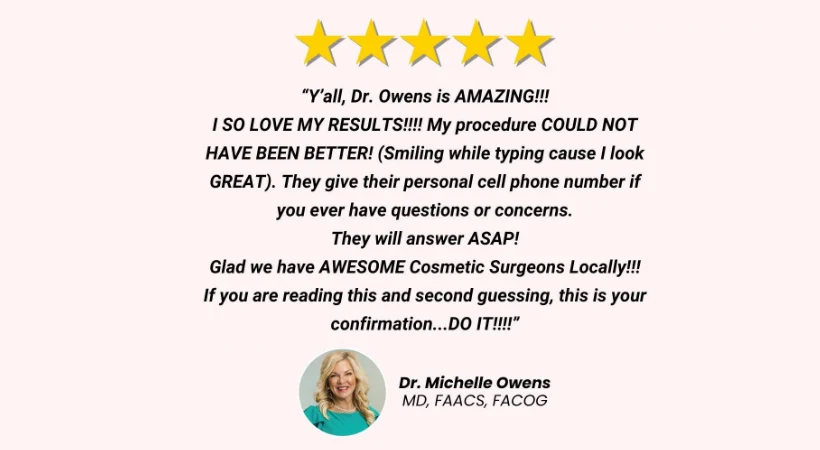
"Dr Owen's is excellent with patient care and explaining in detail should any questions arise. Staff is very friendly and professional. Always made to feel comfortable when visiting the office. Highly recommend!"
You came to this article worried about what could go wrong, and that instinct deserves credit. The same carefulness that made you research labiaplasty risks is what will help you choose a safe surgeon and protect your recovery.
Keep the essentials close. Complications are uncommon and mostly preventable, your own habits protect your healing, and the surgeon you choose is the single biggest safety decision you'll make. If it helps to see real outcomes first, you can browse before and after results from our own patients.
When your questions are ready, reach out to our team for a free consultation, or call us at 337-785-2006.
At Acadia Women's Health in Crowley, we understand the body you have and the body you want, and we'll give you honest answers either way. Whatever you decide, you deserve to feel safe, informed, and at ease with your decision.
Overall complication rates are low, and most issues are minor ones like swelling or a small area of stitch-line separation that heals with simple care. Serious problems such as infection or lasting numbness are uncommon in published reviews. Careful surgical technique and good aftercare keep those odds firmly in your favor.
Yes. Swelling can press on the small nerves in the area, so patches of numbness or odd sensitivity are a normal part of early healing. Feeling typically returns gradually over weeks to a few months, and you should mention any lingering numbness at your follow-up visits.
You can. Labiaplasty only reshapes the outer tissue and doesn't affect pregnancy or vaginal delivery. Keep in mind that childbirth can stretch and change the area afterward, so some women prefer to wait until they're done having children, though that's a personal choice to weigh with your provider.
Most surgeons recommend waiting about six weeks before sex, and the same window applies to strenuous exercise. That pause protects the fine stitch line while the tissue regains its strength. Your surgeon will confirm your personal timeline at your follow-up visits.
Labiaplasty is almost always an out-of-pocket cosmetic procedure, and insurance generally doesn't cover cosmetic surgery. Our practice doesn't file cosmetic procedures with insurance, which is why we offer financing through Cherry, Affirm, and CareCredit, plus layaway plans and free consultations to talk through the numbers.
You'll see the new shape early, but swelling takes time to settle. Most of it fades within the first several weeks, and the final, settled result typically shows over a few months as the tissue softens. Patience during that window pays off.
The most common signs are labia reduced so much that the vaginal opening feels exposed and dry, noticeably uneven or scalloped edges, thick or painful scarring, and ongoing discomfort with sitting, exercise, or sex. If this describes your experience, a revision consultation with an experienced surgeon can map out real options.
Both are safe in experienced hands, and neither is wrong. The wedge removes a small V of tissue and hides the seam, though it carries a somewhat higher chance of wound separation. The trim reshapes the free edge directly. The safer technique is simply the one that fits your anatomy, chosen by a surgeon who performs both.
In many cases, yes. Surgeons can rebuild coverage and smooth uneven edges using nearby tissue, and most women in published repair series saw meaningful improvement in comfort and appearance. Surgeons usually recommend letting the area heal for several months first, so revision starts with an unhurried consultation.
Disclaimer: This article is for general educational purposes only and is not medical advice. Reading it does not create a physician-patient relationship. Every patient is different, individual results vary, and no outcome is guaranteed. Talk with a qualified physician about your specific situation before making any treatment decision.

Written by
Cosmetogynecology, Board-Certified Gynecologist
Fellow of the American Academy of Cosmetic Surgery; Fellow of the American Academy of Facial Esthetics; Fellow of the International Society of Cosmetogynecology (ISCG). Medical Degree: University of Mississippi School of Medicine; Residency: Orlando Regional Healthcare System as Chief Resident.
Our board-certified team offers personalized, judgment-free consultations to help you decide what's right for you.
RECENT POST
BROWSE BY CATEGORY
VISIT US
527 Odd Fellows Road STE B
Crowley, LA 70526
(337) 514-4369
Mon – Thu 8:00 – 5:00
Friday 8:00 – 12:00
%20(SM).png)
(sm).png)
(SM).png)