Acadia Women's Health
October 20, 2026
min read

Timing is usually the last thing to settle, and it is harder than it looks, because the honest answer is not a date on a calendar. A tummy tuck waits on the changes your body is still going through after a pregnancy or a large weight loss. Operating before those changes settle means working on a stomach that is still moving, and later loss or gain can loosen the skin that was just tightened.
There are clear markers for readiness, and surgeons have used them for years. Mayo Clinic advises keeping your weight stable for about 6 to 12 months first.
Acadia Women's Health is a women's practice in Crowley, Louisiana, and this is one of the most common questions we hear across Acadiana. Below is how to read your own timeline, what the surgery changes, whether you are a safe candidate, and what recovery asks of a house with kids in it.

The right time is when four things have settled: your healing, your hormones, your weight, and your family plans. Not one of those is a calendar date, which is exactly why the answer feels slippery when you search for it.
Start with healing. After a delivery, your uterus shrinks back, postpartum bleeding stops, and any cesarean incision closes and matures. Most surgeons want at least six months from delivery, and many prefer nine to twelve. The body keeps changing for a good part of that first year.
Breastfeeding is its own clock. Nursing keeps hormone levels shifting, and those shifts affect both your weight and your tissue. Surgeons commonly ask for six weeks after you finish, and often closer to three months.
Then there is weight, which is the piece that usually takes the longest to settle. The standard is not your goal weight. It is a weight you can actually hold, within about 10 to 15 pounds, steady for 6 to 12 months.
What is settling
Usual window
Why it matters for your result
Healing after delivery
6-12 months
Tissue is still remodeling, and swelling can hide your real shape
Breastfeeding
6 weeks to 3 months after weaning
Hormones and weight keep shifting while you nurse
Weight
Stable 6-12 months
Later loss or gain can loosen the skin that was just tightened
Weight-loss medication or bariatric surgery
Until the plateau holds
Nutrition and protein levels need to be corrected first
Family plans
Ideally complete
Another pregnancy can stretch the repair again
Weight-loss medications add a newer wrinkle. If you are still climbing to your full dose, that is not the moment for elective surgery. Your weight is still moving and your appetite is still changing.
The same is true after bariatric surgery, only more so. Rapid loss can leave you short on iron, B12, vitamin D, or protein, and wound healing runs on all four. Correcting them first is not a delay tactic. It is how you get a clean, comfortable recovery.
A tummy tuck removes the loose skin across your lower abdomen, takes some of the fat attached to it, and stitches separated abdominal muscles back together. That is the whole job, and knowing its edges makes the timing decision easier.
Muscle repair is the part women underestimate. During pregnancy, the two vertical muscle columns down the middle of your belly can drift apart, a bit like a zipper coming undone. That is diastasis recti, and it is structural. Once the tissue between those columns has stretched, core work keeps the muscles strong, and it is the surgical repair that brings them back together.
Loose skin is the other half. Skin that stays stretched over a pregnancy or over a much larger body loses some of its ability to snap back. Once that fold exists, it is a physical thing, and surgery rather than exercise is what removes it.
Stretch marks are a more mixed answer than you usually hear. The marks sitting on the skin removed below your navel come off with it. The ones above your belly button, on your hips, or on your breasts stay, because they are scars in the deeper layer of the skin.
Fat is where most of the misunderstanding sits. A tummy tuck takes the fat attached to the skin it removes, and that is all. It is not a fat-removal operation, which is why the scale barely moves for most women afterward.
Where you are coming from changes the picture too. Pregnancy usually leaves a specific pattern: looseness low, stretch marks low, muscle separation up the midline. A large weight loss more often leaves skin loose in several directions at once, sometimes across the flanks and back as well.
None of that is discouraging. It just means your honest result depends on which of these you are actually dealing with. That is a question a person can answer by looking at you, not by reading an article.
A good candidate is medically stable, at a weight she can hold, well nourished, off nicotine, and okay with the fact that the scar is permanent and sits low. Most healthy women meet that bar. The evaluation exists to find the handful of things that quietly raise your risk so they can be fixed first.
Smoking is the biggest one you control. Nicotine narrows the small vessels that feed healing skin, which is why surgeons want it stopped at least four weeks ahead. Your healing and your lungs both get better in the four to eight weeks after you stop.
Blood sugar matters more than most women expect. In a 2024 meta-analysis of 15 studies covering 79,724 abdominoplasty patients, diabetes was linked to higher odds of complications after surgery. Well-controlled blood sugar going in changes that picture, which is why we check a recent A1c before scheduling.
After a large weight loss, nutrition gets its own look. Low iron, low protein, or low B12 will slow healing no matter how skilled the surgery is. Correcting those takes weeks, not months, and it is one of the most useful things you can do while you wait.
Your history matters too. A cesarean scar can often be removed with the skin that comes off, or folded into the new incision. Previous abdominal surgery, hernias, or scar tissue underneath can change what is realistic, so bring the details.
Walk in with these ready and the visit gets far more useful:
You might be wondering whether the visit is really a sales appointment wearing a different name. It is a fair worry. The first visit costs nothing and is one-on-one with a provider, and the point is to tell you what your body can realistically give you, even when the answer is not yet.
Dr. John Gonzalez, MD, FAACS, FACOG is board certified in obstetrics and gynecology by the American Board of Obstetrics and Gynecology and a Fellow of the American Academy of Cosmetic Surgery. He has spent over 25 years in women's health, and he was among the first in Acadiana to perform abdominoplasty in the office under local anesthesia. He and Dr. Michelle Owens built this practice in Crowley in 1999, first delivering babies and later helping the same women with what came after.
Chassidy came in for a consultation before her tummy tuck and left describing it as a conversation rather than an appointment.
"From the second I met her I was overcome with joy, she made me feel so comfortable and loved during my consultation! She is such a joy to speak with, it was almost like two friends catching up rather than a consultation."
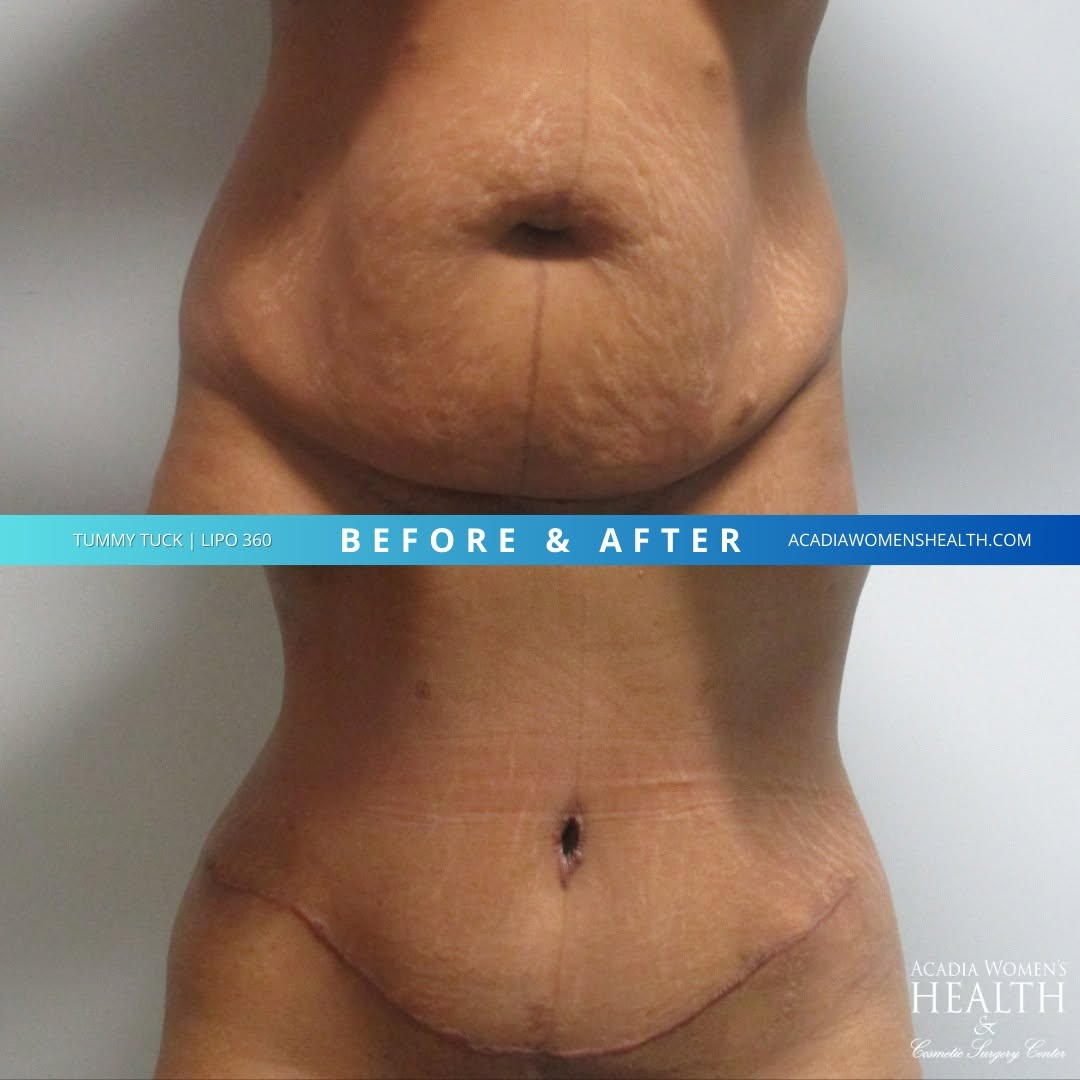
The operation is chosen by where your loose skin actually sits, not by how much weight you lost or how many babies you had. Two women with identical stories can need very different surgeries.
A mini tummy tuck treats a small pouch below the belly button and tightens only the lower abdominal wall. The incision runs about the length of a cesarean scar, just above the pubic area, and the navel usually stays where it is. It suits a modest amount of loose skin; after a pregnancy, most women get a better result from a version that reaches higher.
A traditional tummy tuck removes the skin between the navel and the pubic area, hip to hip, and tightens the muscle wall above and below the belly button. This is the version most post-pregnancy and post-weight-loss patients need, because the looseness usually runs higher than a mini can reach.
A Brazilian tummy tuck pairs liposuction with skin removal from the lower abdomen, shaping the waist while taking the excess. Liposuction removes stubborn fat around the waist and flanks that has stayed put since your weight settled. It cannot tighten skin that has lost its elasticity, and where that elasticity is limited the surface can settle less smoothly.
After a very large weight loss the picture sometimes gets bigger. When skin hangs both downward and outward, a standard tuck may not reach all of it. Some women need an operation that removes tissue in two directions, or one that continues around the sides.
A panniculectomy is a different operation again. It removes a heavy overhanging apron of lower belly skin when that fold causes rashes or gets in the way of moving, without reshaping the waist or repairing muscle.
Then there is the combining question. Acadia Women's Health performs abdominal, breast, and body procedures in the same practice and the same accredited in-office suites, so combining them is a conversation rather than a referral. A mommy makeover pairs a tummy tuck with breast procedures into one process, which means one recovery instead of two.
Combining is not automatically the right answer. Long operating times, several procedures at once, or health factors that raise your risk are all reasons to stage the work instead. Which version fits you is a surgical decision, made with you once someone has examined you in person.
Recovery after a tummy tuck is a logistics problem at least as much as a pain problem. That is the part that surprises women, and it is the part you can solve in advance.
The first week asks the most. You will be sore, you will move slowly, you will stand up bent forward for a few days, and you may have small drains. Short, frequent walks around the house start almost immediately, because moving early is what protects you from clots.
Then things loosen. Driving becomes possible once you are off sedating pain medicine and can brake without hesitating. Many women manage cooking and errands inside the first two weeks, though most take up to a month before going back to work.
The lifting restriction is the one to plan hardest around. You cannot pick up a toddler for the first several weeks, so the help you arrange for that is what makes these weeks easy. If you have a child who still needs carrying, that fact alone should shape when you schedule.
So line up the help before you pick a date:
Schedule around your life, not around how ready you feel today. A stretch when school is predictable, or when a partner can take real leave, is worth waiting months for.
Money deserves the same planning. These are out-of-pocket cosmetic procedures, so Acadia Women's Health offers flexible financing through Cherry, Affirm, and CareCredit, plus layaway and a 4 percent discount for cash. Hard exercise waits until around week six with your surgeon's approval.
The patient portal is where you can message the team with a question between visits, manage your follow-up appointments, and pull up your records and forms without picking up the phone.
Some symptoms deserve a phone call rather than a wait-and-see. Pain that is worsening instead of easing, a fever, spreading redness, or sudden swelling in one leg all belong in that group.
A tummy tuck is real surgery, and the honest version includes what can go wrong and what changes slowly. Knowing both is what lets you plan a result that lasts rather than one that surprises you.
The problems surgeons watch for are fluid collecting under the skin, bleeding, slow wound healing, infection, and blood clots. In a prospective study of 500 patients having abdominoplasty after major weight loss, total complications came to 15 percent. Slow wound healing and fluid collections were the most common, clots by far the rarest, in a group that sits at higher risk than a healthy post-pregnancy patient.
Numbness is not a complication so much as a stage. The skin across your lower belly is lifted during surgery, so the small nerves in it take time to recover. Most of that sensation returns over the first year, though a patch near the scar can stay permanently different.
Swelling is slow to settle, and it is worth expecting that from the start. Most women feel roughly normal around eight weeks, but the last of it can take three months or more. What you see at six weeks is not your result.
The scar is permanent and it sits low, generally along the swimsuit line. It looks its angriest in the early months, then fades and flattens over about a year. Knowing that curve going in is what makes the early months easy to sit with.
Your weight is the biggest thing you still control after surgery. A large gain or loss afterward can loosen skin that was just tightened, which is exactly why this whole conversation started with stability. Staying near the weight you had at surgery is what protects the shape.
A future pregnancy is the other one. It can stretch the skin and the muscle repair again, so surgeons generally advise postponing surgery if another baby is likely. Doing this when your family feels complete means the work you recover from is work that stays.
Adelaide had her tummy tuck with liposuction and was watching her scar settle at the two-week mark.
"I'm only two weeks out and can already see how fine and thin the scar will be, he really couldn't have done a more beautiful job and you can see the true attention to detail he has with his work."
You came in with the decision already made and one open question attached to it. The honest answer is that a tummy tuck rewards patience, because a body that has finished changing holds its result. Waiting is not losing time. It is protecting the thing you are about to spend money and recovery on.
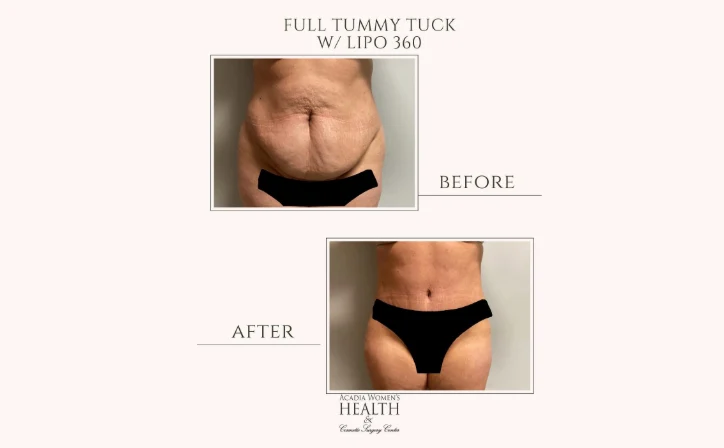
There is plenty you can do while you wait. Real before and after photos are the fastest way to see what this surgery does and does not change.
Get your weight steady, and sort out your nutrition if a big loss is behind you. Then put your questions in front of someone who can look at your body and answer them. You can talk it through with us with no obligation to pick a date.
That is the whole approach at Acadia Women's Health. We would rather help you get the timing right than get you on the schedule. Our number is 337-785-2006.
Most surgeons ask for at least six months after delivery, and many prefer nine to twelve. Your body keeps changing through much of that first year, and swelling can still be hiding your real shape. A cesarean delivery or a complicated recovery can push the timeline out further.
Surgery is generally postponed until you have finished nursing. Breastfeeding keeps your hormones and your weight shifting, and both affect how your tissue settles. Surgeons usually ask for at least six weeks after weaning, and often closer to three months.
You need a stable weight, which is not the same thing. Most surgeons want you within roughly 10 to 15 pounds of where you plan to stay, and hold steady there for 6 to 12 months. If you still have a large planned loss ahead, that comes first.
Some of them. Stretch marks sitting on the skin that gets removed below your navel come off with it, which is often a meaningful share of the worst ones. Marks above your belly button, on your hips, or on your breasts stay, because they are scars in the deeper layer of the skin.
Yes, and it is one of the main reasons women have the surgery. The two vertical muscle columns down your midline are stitched back toward each other, which flattens the bulge that core work cannot reach. The muscles are not cut or shortened, only brought back together.
No. It removes loose skin and the fat attached to it, so the scale usually barely moves. Think of it as the operation that finishes a weight loss you have already done, not one that does the losing for you.
Pregnancy is still possible, and a tummy tuck does not affect your uterus, your ovaries, or your ability to conceive. What it can do is stretch the skin and the muscle repair again, which may soften the result you recovered from. That is why surgeons generally suggest waiting until your family feels complete.
Very little, and that is not what it is for. The tissue removed varies with how much loose skin you have, but this is a shaping operation rather than a weight measure. Women usually notice the difference in how clothes fit long before they notice anything on the scale.
A panniculectomy removes a heavy hanging apron of lower abdominal skin and nothing more. It does not repair separated muscles, reposition the belly button, or shape the waist. A tummy tuck does all three, which is why it is the contouring choice when the goal is your overall shape.
Not always. Liposuction helps when there is stable fat around the waist or flanks that the tuck itself will not reach, and it is often combined for exactly that reason. It cannot tighten skin that has lost its elasticity, so it is an addition to the plan rather than a replacement for one.
Plan on another adult at home for at least the first two nights and real help for two to three weeks. You will not be able to lift a small child for several weeks, so that piece needs a plan before anything else. Most women take up to a month away from work. The arrangements you make before surgery day will do more for your recovery than almost anything you do after it.
Disclaimer: This article is for general educational purposes only and is not medical advice. Reading it does not create a physician-patient relationship. Every patient is different, individual results vary, and no outcome is guaranteed. Talk with a qualified physician about your specific situation before making any treatment decision.

Written by
Cosmetic Surgeon, Board-Certified Urogynecologist
Fellow of the American Academy of Cosmetic Surgeons; Fellow of the American College of Obstetricians and Gynecologists. Medical Degree: University of Miami School of Medicine; Residency: Orlando Regional Healthcare System as Chief Resident.
Our board-certified team offers personalized, judgment-free consultations to help you decide what's right for you.
RECENT POST
BROWSE BY CATEGORY
VISIT US
527 Odd Fellows Road STE B
Crowley, LA 70526
(337) 514-4369
Mon – Thu 8:00 – 5:00
Friday 8:00 – 12:00