Acadia Women's Health
August 13, 2026
min read
A bulge that runs down the middle of the abdomen, one that persists no matter how much core work or healthy eating you do, is one of the most common changes women notice after pregnancy. It often has a specific medical cause rather than being a matter of fitness or willpower.
That cause is usually diastasis recti, the separation of the belly muscles that pregnancy stretches apart. For many women, a mommy makeover with diastasis recti repair is what finally closes it.
The encouraging part is that repair does more than flatten your stomach. In one report from plastic surgeons, the share of women with disabling back pain fell from about half before surgery to just 9 percent six months after the muscles were repaired.
At Acadia Women's Health in Crowley, Louisiana, we help women across Acadiana decide if this is the right step. This article covers what diastasis recti is, how the repair works, who it suits, and what recovery looks like.
Diastasis recti is the separation of your two vertical belly muscles, the ones that run down the front and meet in the middle. They are joined by a band of tissue called the linea alba. When that band stretches and thins, the two muscles drift apart, a bit like a zipper coming undone.
Pregnancy is the most common cause. As the baby grows, the uterus pushes outward against that midline. At the same time, the pregnancy hormone relaxin softens your tissue so your body can make room. That mix of steady pressure and softening lets the gap open up, which is completely normal.
How much of a gap counts? Surgeons measure the distance between the muscles, and a clear, persistent gap, often wider than two finger-widths, generally points to diastasis recti. You do not need to measure yourself, though, because the signs are easier to feel than to size up.
The most familiar sign is a belly that still pooches or domes, especially when you sit up or strain. But it is about more than looks. Many women also notice a weak core, lower back pain, and a little leaking when they cough, laugh, or lift.
Here is the part that surprises people most. If the gap is real and wide, no amount of core work will pull it closed. The issue is the stretched tissue itself, not weak muscles.
As our guide to the post-pregnancy tummy pooch puts it, a million crunches will not fix a structural problem. Knowing that finally lets you stop blaming yourself.
The muscle repair happens during the tummy tuck, the core of most mommy makeovers when diastasis is involved. Diet and exercise can only build muscle around the gap. They cannot bring the separated muscles back together, because the stretched midline does not tighten on its own.
During the procedure, the surgeon lifts the belly skin to reach the muscle wall underneath. Then comes the key step, called muscle plication. The two separated muscles are stitched back toward the middle with strong, long-lasting sutures, almost like lacing them together. That re-creates the firm, internal support your abdomen used to have.
This is where the difference between procedures matters. A diastasis usually runs the full length of your belly, from near the ribs to the pubic area. A full tummy tuck can reach that whole length, while a mini tummy tuck only addresses the lower belly below the navel. That is why most true muscle repairs need a full tummy tuck.
The flattening you see afterward is not just skin deep. Pulling the muscle wall back together relieves the outward pressure that pushes your belly forward. That is why the stomach looks flatter and feels firmer when you stand up straight.
Because it is a mommy makeover, the repair is rarely done alone. Many women add liposuction to refine the waistline, and breast surgery to restore shape after nursing. Combining these into one surgery means one recovery instead of several.
Who does the repair matters too. At Acadia Women's Health, body-contouring procedures like this are performed by our experienced cosmetic surgical team — Dr. Gonzalez and Dr. Owens, who built the practice, along with Dr. Donald Balder, MD, FACS, a Fellow of the American College of Surgeons with over 25 years of experience in tummy tucks and body contouring.
When you are ready, you can book a free consultation and have your abdomen examined, with no pressure to decide that day.
Candidacy is about timing and stability more than a number on the scale. Most surgeons suggest waiting at least 6 to 12 months after giving birth, and after you finish breastfeeding. That gives your body time to recover and your hormones time to settle, so your result reflects your true, healed shape.
Being finished having children is the other big piece. A future pregnancy stretches the abdominal wall again and can separate muscles that were just stitched together. None of this means you must decide forever today. It simply means the repair lasts best when your family feels complete.
Weight stability matters more than a specific goal weight. Our note on timing a mommy makeover after pregnancy focuses on your body not being in flux, not on hitting an ideal number. A weight that has held steady for several months helps your results stay consistent.
A common worry is a hernia. If you have a small belly-button or other hernia along with the separation, it does not rule you out. Surgeons can often repair a hernia at the same time as the muscles, so one surgery addresses both.
What about physical therapy first? For mild separation, guided core rehab is a sensible starting point. But when the gap is wide and symptoms persist, exercise often is not enough.
For many women, a wide gap simply does not respond to exercise, because therapy strengthens the muscles around it without closing the stretched tissue. Surgery becomes the reasonable choice once the conservative route has had a fair try.
You might be wondering, "Will they actually listen, or just push me toward surgery?" That is a fair question. It is exactly why the first visit is a conversation, not a sales pitch.
The consultation is free, and it is as much your chance to evaluate us as it is ours to examine you. We take the time to look at your abdomen and talk through whether repair or rehab fits you. We also explain costs and flexible financing, including Cherry, Affirm, and CareCredit, so the money side is clear before you decide.
Samantha found the kind of unhurried, two-way conversation a consultation is meant to be.
"she truly listened. Every concern I had was taken seriously, and she took the time to explain everything and make sure I felt confident moving forward. I never once felt rushed or unsure."

Recovery is a real process, and knowing the arc ahead of time makes it far less daunting. The first week is the most restful. You will have swelling and soreness managed with medication, and you will likely stand and walk slightly bent forward at first. Plan on real help at home for those early days.
Most women with desk jobs feel ready to return to light work after about 2 weeks, once they are off prescription pain medication. If your job involves standing or lifting, give it closer to 3 to 4 weeks. The goal is to protect those internal stitches while the muscle wall knits back together.
You will wear a compression garment, which supports the repair and helps swelling go down. Most surgeons have patients wear firm compression nearly around the clock for the first few weeks, then ease into lighter support. It can feel like a lot at first, but most women come to find it reassuring.
Here is the timeline at a glance:
Time after surgery
What most women can expect
Week 1
Rest, swelling, soreness; help needed at home
Weeks 2 to 3
Return to a desk job; light daily tasks; no lifting
Weeks 4 to 6
Lighter compression; gradual return to gentle cardio
Around week 6
Cleared to lift children and heavier objects again
Weeks 8 to 12
Core exercises like planks and crunches resume
The hardest restriction for moms is usually lifting. You will need to avoid picking up anything heavier than about 5 to 6 pounds, including your little ones, for roughly the first 6 weeks. Lining up childcare and helping hands before surgery makes this stretch much smoother.
Direct core work waits the longest. Planks, sit-ups, and crunches stay off-limits until your surgeon clears you, often around 8 to 12 weeks. Throughout recovery, you are never on your own. You can message the team through the patient portal. Because Acadia Women's Health performs these procedures in its own accredited, in-office surgical suites, your follow-up care stays right here in Crowley.
The results are both visible and functional, which is what most women are hoping to see. The most obvious change is a flatter, firmer midsection. But re-joining the muscle wall also rebuilds the core support you lost. Many women notice standing taller and feeling more stable as they go about their day.
That restored support reaches further than you might expect. A review of 780 patients who had diastasis repair found consistent gains in core strength and real relief from lower back pain. When your abdominal wall does its job again, your spine gets the support it was missing.
Many women also see help with bladder leakage, which is common after childbirth and nothing to feel embarrassed about. You are far from alone, and you do not have to just live with it. In one study of 100 women, urinary leakage improved significantly after repair. Results vary from person to person, so this is something to discuss honestly at your consultation rather than count on.
The trade-off people think about most is the scar. The incision sits low across the lower abdomen, within the bikini line, so most underwear and swimsuits cover it. As our scar care guide explains, with good aftercare these scars usually fade into soft, pale lines over the first 6 to 12 months.
Swelling settles gradually, so the final shape takes patience. Most of it eases over the first few months, with the truest result showing once everything has calmed down. As long as your weight stays steady and you do not have another pregnancy, the muscle repair itself is built to last.
Adelaide described the change a lot of moms notice after years of a stubborn midsection.
"I had a tummy tuck with LIPO 360 and a breast augmentation. The results are SO natural with the breast augmentation and that's EXACTLY what I wanted and for someone who has always had a stubborn mid section to see a flat stomach on me has just been mind-blowing."
If you have done everything right and still feel that gap down the middle, you are not stuck. It makes sense to learn what a mommy makeover with diastasis recti repair can do for you. The separation that workouts could not close is exactly what this surgery is built to fix.
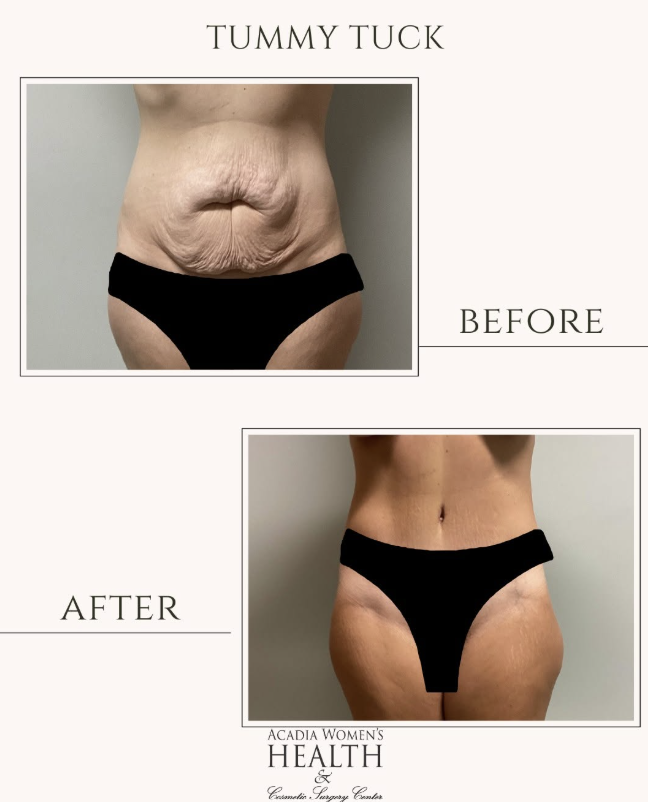
A good way to start is simply to look. Browsing real before-and-after results can help you picture your own outcome.
When you feel ready, you can reach out to our team for a free consultation, with no pressure to decide that day. It is just an honest conversation about your body, your options, and your timing.
You do not have to have it all figured out before you call. Acadia Women's Health is right here in Crowley, serving women across Acadiana. We would be glad to help you feel comfortable in your own skin again, so to start, call us to schedule at 337-785-2006.
A true muscle repair almost always requires a tummy tuck, because the surgeon needs access to the muscle wall to stitch it together. For mild separation, physical therapy may help. But for a wide, persistent gap, exercise alone usually cannot close it.
Many women do get real relief. When the abdominal wall is repaired, your core supports your spine again, which often reduces the back pain that came with a weak midsection. Individual results vary, so it is worth discussing your symptoms at a free consultation.
It is safe to get pregnant afterward, but another pregnancy can stretch the muscles apart again and undo your result. That is why surgeons usually recommend waiting until you are finished having children. If more pregnancies are likely soon, it may be worth timing your surgery accordingly.
Lie on your back with knees bent, then lift your head and shoulders slightly while pressing your fingertips along the midline of your belly. If you feel a gap or soft channel between the muscles, that can suggest diastasis. A hands-on exam confirms how wide the separation really is.
When the repair is part of a cosmetic mommy makeover, it is elective, and Acadia Women's Health does not file cosmetic procedures with insurance. Our team can walk you through costs and flexible financing so the path forward is clear.
Physical therapy can strengthen the surrounding muscles and is a smart first step for mild cases. For a severe, wide separation, it usually cannot bring the stretched midline back together. In those cases, surgical repair is what actually closes the gap.
Most surgeons suggest waiting at least 6 to 12 months after delivery, and until after you finish breastfeeding. This gives your body time to heal and your weight time to stabilize, so your results reflect your true, recovered shape.
Often, yes. A tummy tuck typically removes the lower-belly skin where a C-section shelf or scar bulge sits. The new incision usually follows that same low line, and many women find the area looks smoother and flatter afterward.
Muscle plication is one step within a tummy tuck. The tummy tuck is the overall procedure that removes loose skin and refines the shape. Plication is the specific part where the separated muscles are stitched back to the midline. You generally cannot have one without the other.
In a standard repair, the muscles are stitched together directly, without mesh. Mesh is sometimes added when a hernia is present alongside the separation, for extra reinforcement. Your surgeon will explain whether your situation calls for it.
Yes, this is common. A small belly-button hernia can often be repaired during the same surgery as the muscle separation, so you address both with one recovery. It is one of the things our surgeons check for during your consultation.
*Disclaimer: This article is for general educational purposes only and is not medical advice. Reading it does not create a physician-patient relationship. Every patient is different, individual results vary, and no outcome is guaranteed. Talk with a qualified physician about your specific situation before making any treatment decision.

Written by
Cosmetic Surgeon, Board-Certified Urogynecologist
Fellow of the American Academy of Cosmetic Surgeons; Fellow of the American College of Obstetricians and Gynecologists. Medical Degree: University of Miami School of Medicine; Residency: Orlando Regional Healthcare System as Chief Resident.
Our board-certified team offers personalized, judgment-free consultations to help you decide what's right for you.
RECENT POST
BROWSE BY CATEGORY
VISIT US
527 Odd Fellows Road STE B
Crowley, LA 70526
(337) 514-4369
Mon – Thu 8:00 – 5:00
Friday 8:00 – 12:00
%20(SM).png)
(sm).png)
(SM).png)