Acadia Women's Health
October 12, 2026
min read

A before and after gallery is the first place most people look, and it is the hardest place to get a real answer. A photograph shows you someone else's body. It rarely tells you where that woman started, when the picture was taken, or how much of the change came from the tummy tuck itself. That makes it a poor tool for predicting your own result, even though it is the tool almost everyone uses.
Satisfaction is easier to measure than a photograph is to read. In a follow-up study reported by the American Society of Plastic Surgeons, 94 percent of patients were satisfied with their result about 15 months after surgery. And 97 percent said they would choose it again.
At Acadia Women's Health in Crowley, Louisiana, a good part of every consultation goes to matching what a woman hopes for against what her own body can give her. Below is what the surgery can and cannot change, how to read a gallery honestly, how the result develops month by month, and what keeps it.
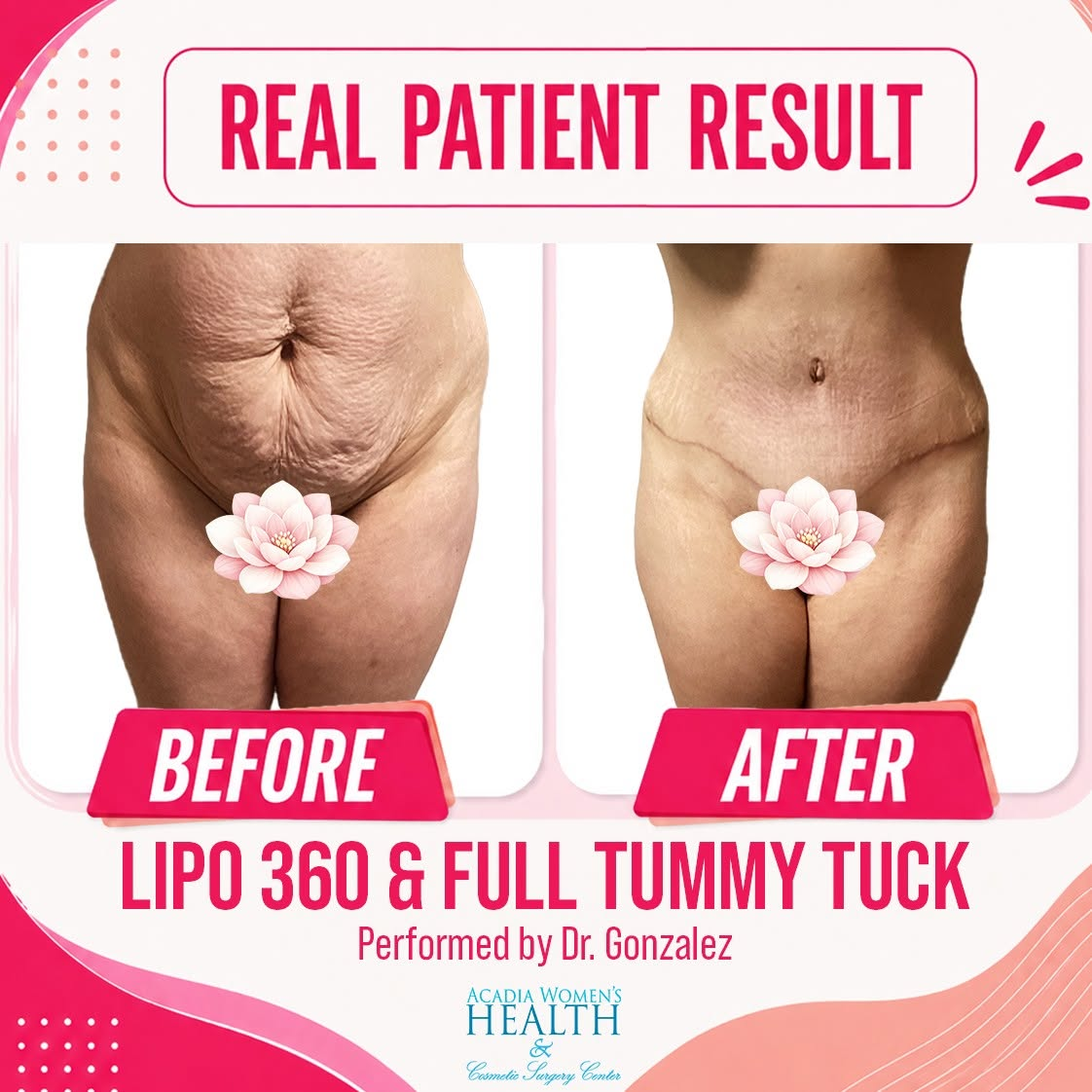
A tummy tuck changes two layers: the skin you can see and the muscle wall underneath it. It removes loose lower-abdominal skin along with some of the fat sitting right under it, and it tightens the muscle wall when that wall has stretched.
The muscle part is what most women do not expect. Pregnancy can pull apart the two vertical muscles that run down the middle of your belly, a bit like a zipper coming undone. That gap is why a stomach can still pooch after the weight is long gone.
Stitching those muscles back together flattens the pooch and rebuilds the support you feel when you stand up straight. It is also the reason a tummy tuck can change how your midsection works, not just how it looks.
Stretch marks come up in nearly every consultation. Marks that sit in the skin being removed, usually the ones below your belly button, come off with it. Marks above the navel or out on your hips generally stay, though the upper skin gets pulled lower and they can look less obvious afterward.
It helps to be clear that this is contouring surgery, not weight-loss surgery. It does not reach the deeper fat around your organs, and it is not a substitute for getting to a weight you can hold. What it does do is change the shape that diet and exercise could not reach.
That said, the scale often keeps moving in a good direction. A follow-up study reported by the American Society of Plastic Surgeons found that most patients keep losing weight in the months and years after abdominoplasty, averaging about 10 pounds by the five-year mark.
There are honest limits worth naming. Cellulite stays. Skin outside the treated area stays. And the trade for a flatter abdomen is a permanent scar, placed low so it sits under your underwear line.
The version you have shapes the result too. A mini tummy tuck works on the lower belly only, through an incision about the size of a c-section scar. A traditional tummy tuck removes the skin between the navel and the pubic bone from hip to hip and tightens the whole wall.
A Brazilian tummy tuck pairs skin removal with liposuction so the waist gets shaped at the same time.
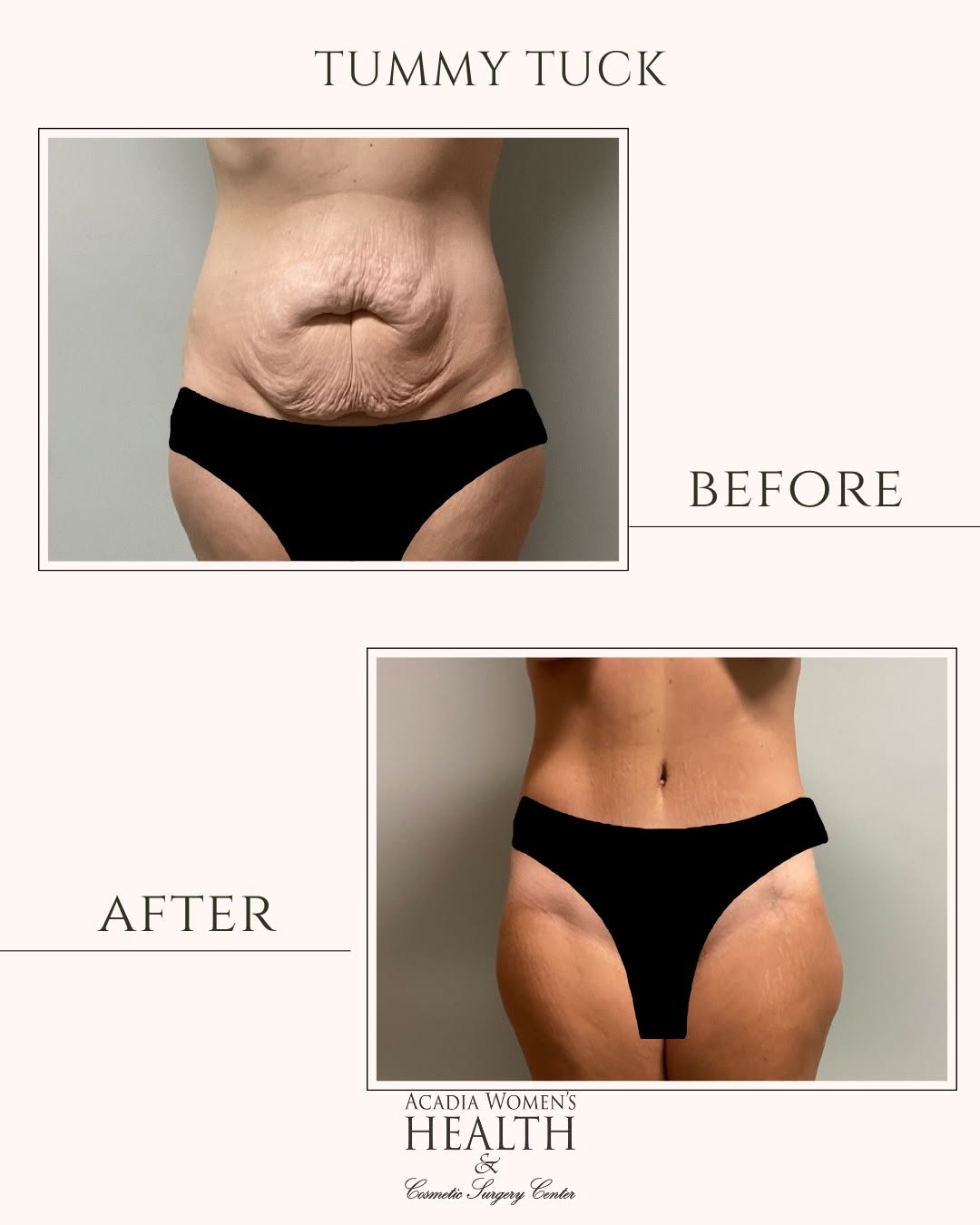
Read a gallery as a comparison, not a promise. The photos are real, but they are a selected set, and their value depends almost entirely on how closely the woman in them started out like you.
So start with her, not with the after. How many pregnancies, how much loose skin she began with, whether she has a c-section scar, and whether her surgery included muscle repair or liposuction alongside the skin removal.
A good gallery tells you those things. Reputable case notes list pregnancy count, incision type, whether the navel was moved, and how much time had passed.
Then check the two photos against each other. The American Society of Plastic Surgeons tells patients to look for standard medical views with consistent lighting and camera angles, and to be suspicious of images that seem to defy gravity.
Same distance, same angle, same posture, similar clothing. If the before is a slouch under hard overhead light and the after is softly lit and standing tall, some of that change is photography.
Timing is the question people forget to ask. Good galleries label how long after surgery each photo was taken, and those intervals vary a lot from case to case. A two-month abdomen is still carrying swelling, so it is not telling you the same thing a one-year photo does.
Here is what is actually worth looking at once you have the context.
What to look at
What it tells you
Her starting point
Whether the comparison is fair for your body
Time since surgery
Whether you are seeing a settled result or a swollen one
The waist and flanks
Whether the shape is proportionate, not only flatter
The navel
Whether it looks natural and centered rather than tight or slit-like
The scar
A low, continuous line is realistic. An invisible one is not
Lighting, pose, clothing
Whether the change is surgical or photographic
One more thing about galleries in general: they are a selected sample by nature, so ask to see more than the highlight reel. Consecutive cases and longer follow-up photos tell you far more than three perfect pairs.
Acadia Women's Health keeps its own tummy tuck photos on a separate, age-gated site. That is deliberate, so the women in them stay private.
When you want to look with these questions in hand, you can view the tummy tuck gallery and judge the work for yourself.
The abdomen you see at two weeks is not the one you are signing up for. Almost everything that makes an early result look wrong is temporary, and knowing the sequence keeps the first month from feeling like a mistake.
Through the first two weeks, expect swelling, bruising, tightness, soreness, numbness across the lower belly, and a posture that stays slightly bent. Walking is usually the only activity on the list. This stretch is about healing, not about assessing anything.
Somewhere in weeks three through six, you start to stand straighter and move more easily. Most of the bruising and the obvious swelling settle in this window. Heavy lifting stays off the table until at least the six-week mark, and real core work waits considerably longer.
By about three months, the contour is usually clear. Most of the major swelling has gone down, and this is the first point where the shape in the mirror resembles the shape you will keep. Some firmness and a little fullness low on the abdomen often linger.
Between three and six months, things keep softening. Deep swelling continues to drain, flexibility returns, feeling comes back in patches, and the scar starts to flatten and lose its early color.
The abdomen can still change between six and 12 months. Internal scar tissue softens, the fluid your body was holding finally clears, and nerves gradually wake back up. Numbness that felt permanent at three months is usually much better by a year.
Scars run on their own clock. Redness, firmness, and unevenness typically mature over eight to 12 months, and sometimes longer. A scar you dislike at four months is very often one you barely notice at 14.
If the first weeks feel discouraging, that is normal, and it is not a signal about your result. It is very common to hit a stretch where you quietly wonder whether it worked. That feeling tends to ease as the swelling does, somewhere around month three.
Heather wrote her update at four weeks, right in the middle of that window.
"I am four weeks postop from a tummy tuck and muscle repair with Dr. Gonzalez and it has gone above and beyond anything I could have ever imagined. The recovery has been amazing and honestly so easy. I feel so great, and I don't even think I was mentally prepared for what I would look like, because I could not imagine it. My scar is pretty perfect, if scars can be beautiful it is and it healed so quickly. I have this really cute new little belly button that makes me smile every time I look at it. Pretty much all my stretch marks are gone and I'm not mad about that."
Two women can have the same operation and walk away with different results. Most of the reasons are knowable before you ever pick a date, and most of them are things you can do something about.
Where you start matters most. Skin with some spring left in it holds a smoother contour, and a weight that has been steady puts less tension on the closure. Mayo Clinic suggests holding a stable weight for six to 12 months before surgery for that reason.
Technique decides the details you will actually study in the mirror. Whether separated muscle gets repaired, how smoothly the fat and skin are tapered at the edges, how deep and natural the navel sits, and how low the incision is placed.
Scar position is a good example of how much planning shows up later. An incision placed low, so it disappears under the waistband of your underwear, is a decision made before surgery starts, and it is one of the things women are most glad about a year on.
A few health factors move the odds more than most women expect:
Smoking is the one worth acting on. Nicotine narrows the small vessels that feed healing skin, and studies consistently find more wound and bruising problems in smokers than in nonsmokers. Stopping well before surgery is the single most useful thing you can do for your own result.
Healing itself can shape the early appearance too. A pocket of fluid the body reabsorbs, a slow-healing spot, or uneven swelling can make one side look different for a while. Most of it settles, which is why final judgment usually waits until somewhere around six to 12 months.
Who does the surgery matters too. Dr. John Gonzalez is board certified in obstetrics and gynecology by the American Board of Obstetrics and Gynecology. He is also a Fellow of the American Academy of Cosmetic Surgery, has practiced for more than 25 years, and was among the first in Acadiana to perform abdominoplasty in the office under local anesthesia.
He built the practice with Dr. Michelle Owens, who has been in private practice in Crowley since 1999 and works in facial and body contouring.
None of that is something you can size up from a website. The consultation is free, and it is a one-on-one visit with one of our providers, so you get an honest read on your own abdomen before anyone talks about scheduling.
That conversation goes both ways. It is your chance to ask what is realistic for your body, see cases closer to your starting point, and get clear numbers on cost and payment options.
A tummy tuck result is durable, not frozen. The muscle repair holds, the removed skin does not come back, and a steady weight is what keeps the shape looking the way it did at six months.
It is not about being strict with yourself. It is about staying in about the same place. Large swings up and down stretch and shrink the remaining skin, and repeated crash dieting is harder on a contour than a stable few pounds either way.
Pregnancy is the bigger variable. Carrying a baby can re-stretch both the skin and the muscle repair underneath, and how much it changes is genuinely unpredictable. This is why most surgeons suggest finishing childbearing first, and why timing is worth talking about honestly rather than guessing at.
Exercise comes back in stages. Light walking usually starts in the first weeks and normal daily activity around week four. Strenuous exercise generally waits until somewhere between six and eight weeks, with Mayo Clinic advising at least eight weeks before sports, and your surgeon making the call for your repair. Core work is the very last thing added back.
Scars are permanent, and they fade the most over the first year. Silicone gel or sheets can help, and keeping the scar out of the sun matters more than most people realize. We talk through scar care before surgery and check in with you as you heal.
Aging and gravity will keep doing what they do, gradually and to everyone. That is not a reason to expect the result to fall apart. Women who hold their weight steady commonly enjoy the change for decades.
If something still worries you months later, it is worth raising at a follow-up visit. A bulge that does not settle, a scar that thickens, or an asymmetry that is not improving all deserve a look. Between visits, you can message the team or check your records through the patient portal.
That is part of why women stay with us. Acadia Women's Health also handles gynecology and general women's health, so the team that did your surgery is the team you already see for everything else, including conversations about future pregnancies.
Stacey measured her result in everyday life rather than in inches.
"Dr Owens did an amazing job on my bbl, lipo 360 and tummy tuck. I feel so much confidence in how my clothes fit and she listened to all my concerns and gave me realistic results of what she could do and I couldn't be anymore happier so ready for my trip in Jamaica in July"
Go back to the photos you were comparing. The honest answer is that they were never a preview of your result, because they were never your body. What a tummy tuck can do for you comes down to where you start, how the surgery is planned, and how you heal, and all three of those are things you can actually find out.
A good next step is a slower look at real galleries with the questions from this article in hand. After that, if you want a straight read on your own abdomen instead of someone else's, you can book a free consultation and get one.
Acadia Women's Health is in Crowley, and we see women from across Acadiana who are somewhere in the middle of this exact decision. We understand the body you have and the body you want, and we would rather tell you what is genuinely possible than sell you a picture. You can also reach us at 337-785-2006.
Flatter and firmer, in proportion to your own frame, is the honest way to describe it. How much depends on how much loose skin and fat you started with, whether your muscles need repair, and whether liposuction is added. There is no reliable inches-off number anyone can promise you before an exam.
Not necessarily, and any surgeon who promises one is overselling. It creates a flatter, firmer, more toned-looking abdomen, but your natural build, remaining fat, and skin quality all shape the final look. Most women describe the change as looking like themselves again rather than looking like someone else.
You will notice a change right away, but the real result takes months. Most of the contour is visible by around three months once the major swelling is gone. Smaller changes in firmness, sensation, and scar appearance continue through the first year.
Most swelling eases within the first month, and the obvious swelling is usually gone by about three months. Deeper swelling keeps draining quietly after that, often through the six-month mark, and some women hold a little fullness low on the abdomen for longer still. An abdominal binder is often worn for roughly six to eight weeks, though your surgeon sets your schedule.
The scar is permanent, but it usually fades a great deal over several months to a year. Where it ends up visually depends on your skin, your genetics, how the incision was placed, and how you care for it. It is positioned low so that underwear and most swimwear cover it.
Some of them. Stretch marks sitting in the skin that gets removed, usually below the belly button, come off with that skin. Marks above the navel or on your hips stay, although pulling the upper skin down can make them look less noticeable.
Your navel stays attached where it is on the abdominal wall. In a full tummy tuck the surgeon brings it out through a new opening in the repositioned skin, so its shape or the ring of scar around it can look a little different. A mini tummy tuck often skips this step entirely.
Yes, in most cases. Separated muscles, called diastasis recti, can be brought back together and stitched during the same operation. It does take an exam to confirm that muscle separation is what is causing the bulge, since not every stomach that pooches has it.
There is no honest number to give here, and it is worth being skeptical of anyone who offers one. A tummy tuck is not a weight-loss procedure and will not move the scale much on its own. Clothes usually fit differently because the shape changed, not because you weigh less.
The contour change is meant to last, and with a steady weight it can hold for decades. Aging, large weight changes, and pregnancy are the things that alter it. The muscle repair itself has held up well in follow-up studies, including five-year ones.
Pregnancy can stretch the repaired muscle and the skin above it, though how much varies from woman to woman. That is why most surgeons suggest finishing childbearing before surgery when that is possible. Because our team also handles gynecology and general women's health, this is a conversation we have with women before surgery rather than after.
No. That practice's photos tell you about that surgeon's work, which matters, but you should also weigh credentials, experience, and reviews. Whatever gallery you are in, look for cases with a starting point like yours. Note how long after surgery each photo was taken. Our free consultation is where we pull up the cases that actually match your body.
Disclaimer: This article is for general educational purposes only and is not medical advice. Reading it does not create a physician-patient relationship. Every patient is different, individual results vary, and no outcome is guaranteed. Talk with a qualified physician about your specific situation before making any treatment decision.

Written by
Cosmetic Surgeon, Board-Certified Urogynecologist
Fellow of the American Academy of Cosmetic Surgeons; Fellow of the American College of Obstetricians and Gynecologists. Medical Degree: University of Miami School of Medicine; Residency: Orlando Regional Healthcare System as Chief Resident.
Our board-certified team offers personalized, judgment-free consultations to help you decide what's right for you.
RECENT POST
BROWSE BY CATEGORY
VISIT US
527 Odd Fellows Road STE B
Crowley, LA 70526
(337) 514-4369
Mon – Thu 8:00 – 5:00
Friday 8:00 – 12:00
%20(SM).png)
(sm).png)
(SM).png)