Acadia Women's Health
June 29, 2026
min read

You want the flatter stomach and the lifted shape you remember. What you may be quietly afraid of is trading a body you did not love for a scar you cannot hide.
If that worry has crossed your mind, you are in good company. It is one of the first questions women ask about a mommy makeover, and a fair one to sit with.
Here is the reassuring part. A scar is not a sign that something went wrong. It is simply how skin closes itself, and how it looks in the end is largely something you and your surgeon can shape. In a review of randomized trials, medical-grade silicone treatment measurably flattened scars and faded their color.
At Acadia Women's Health in Crowley, Louisiana, we help women across Acadiana plan for their scars from the start and care for them through healing. This article covers where your incisions sit, how a scar matures over time, the daily care that matters most, and how your surgeon's technique shapes the result.
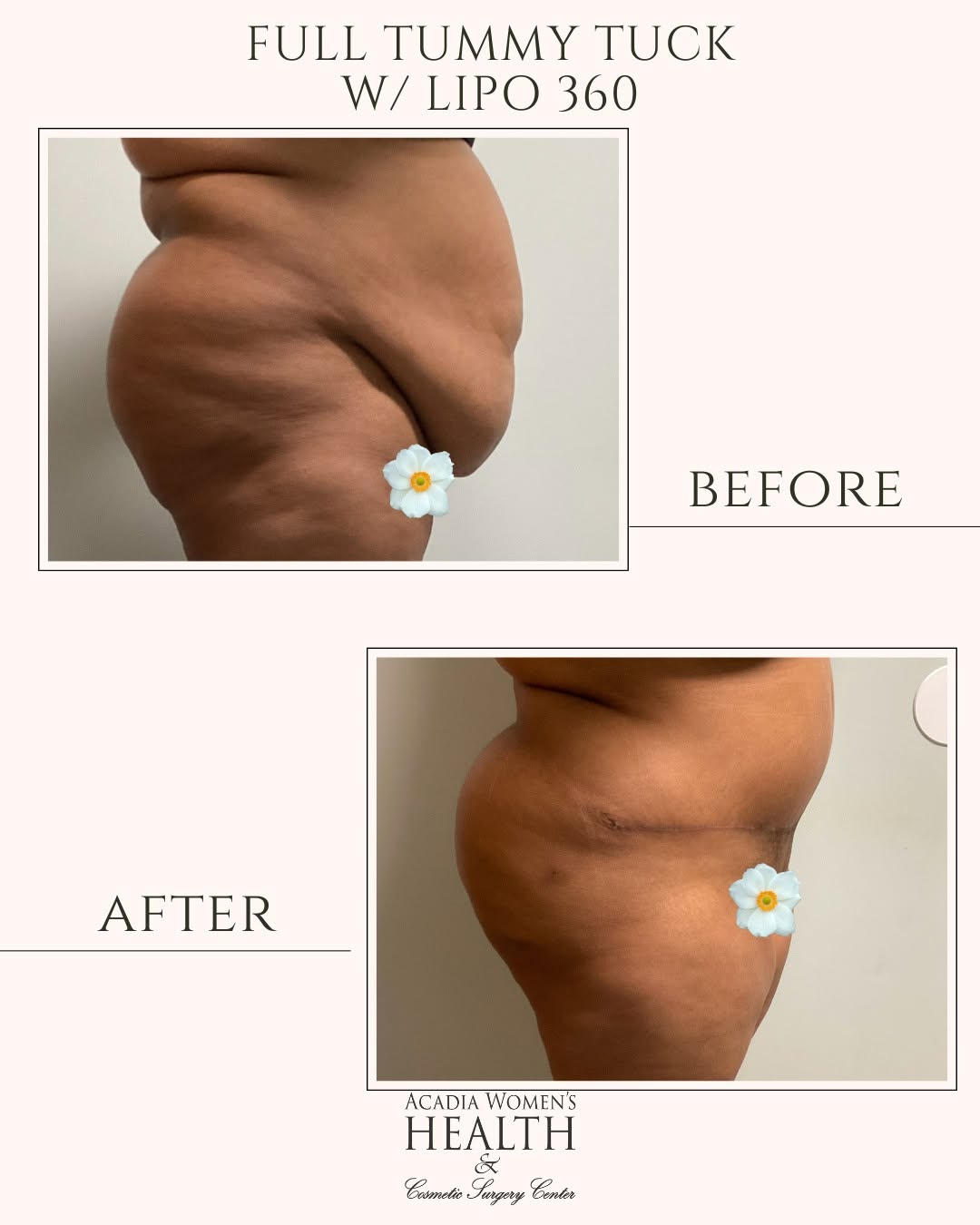
A mommy makeover is a set of procedures chosen for your body, so your scars depend on which ones you have. The good news holds across all of them. Surgeons place incisions where everyday clothing and swimwear cover them, in natural folds and creases rather than out in the open.
The main scar from a tummy tuck sits low and horizontal, within the bikini line, so most underwear and swimsuits cover it. A full tummy tuck removes skin between the navel and the pubic area, so the scar stretches roughly hip to hip. A mini tummy tuck addresses only the lower belly, leaving a much shorter scar, about the length of a c-section line.
There is usually a second, small scar around the belly button. The navel itself is not removed during a full tummy tuck. The skin around it is redraped and a small new opening is made, so many women find their belly button looks a little neater afterward.
A breast lift uses one of two common patterns. A lollipop pattern circles the areola and runs straight down to the crease beneath the breast, and an anchor pattern adds a line along that crease, forming an upside-down T. Which one fits you depends on how much lift your breasts need.
A breast reduction typically follows the same anchor or lollipop pattern, since removing extra tissue calls for similar incisions. In a bra, a swimsuit top, or most everyday shirts, these scars stay covered.
If your plan includes a breast augmentation, the scar is tucked into the fold under the breast, where the natural crease helps hide it. It tends to be the shortest of the breast scars.
Liposuction leaves the smallest marks of all. The thin tube used to remove fat passes through tiny openings about the size of a pencil eraser, which are usually hidden in a crease, the belly button, or the panty line. Most women stop noticing them entirely once they have faded.
Knowing where your scars will fall takes a lot of the fear out of the unknown. Next, let's look at how any of these scars change over time.
A scar is not finished the day your incision closes. It goes through a long, predictable process called maturation, and knowing the stages keeps you from panicking at the point when scars naturally look their worst.
In the first 1 to 2 weeks, the focus is simply closure. Your incisions are held together by sutures or tape, the line looks fresh and pink, and there is no scar to treat yet, only a wound to protect.
Then comes the part that surprises people. Between about weeks 3 and 8, a scar often gets redder, firmer, and slightly raised. That is not a setback. It is your body laying down fresh collagen, a normal sign of healing rather than a warning.
Over the next several months, the tide turns. From roughly 3 to 6 months the scar softens, flattens, and loses its angry color. By 12 to 18 months it is usually flat and silvery, often close to your skin tone.
It helps to be honest about the finish line. A well-cared-for scar fades a great deal, but it rarely disappears completely. The goal is a soft, pale, easy-to-hide line, and that is what good care and patience tend to deliver.

This is where you have the most influence, and it is genuinely a lot. Surgeons place the incision and close it well, but the months of care that follow are yours to own, and they make a real difference in the final result.
Basic protection comes first. For the first couple of weeks, keep each incision clean. Wash gently with mild soap and water, pat it dry instead of rubbing, and stay out of baths, pools, and hot tubs until your surgeon clears you. Active scar treatments wait until the wound has fully closed, usually around 2 to 3 weeks, once the stitches and any scabbing are gone.
Once the incision has closed, medical-grade silicone is the gold standard. Silicone sheets or gel form a thin, protective layer that keeps the scar hydrated and helps it stay flat and pale. Most plans call for wearing or applying it for several hours a day over 2 to 6 months.
Gentle scar massage is the next layer. You can usually start around 2 to 3 weeks, once the tissue is strong enough. A few minutes a couple of times a day, using a plain moisturizer, helps break up the stiff collagen that makes a scar feel ropey, and many women see a real improvement.
Sun protection may be the most underrated step of all. A new scar has little natural pigment to defend itself, so sun exposure can turn a fading pink line a permanent brown, something the American Society of Plastic Surgeons warns about directly. Keep healing scars covered or under a sunscreen of SPF 50 or higher for a good 12 to 18 months.
At Acadia Women's Health, you do not have to piece this together on your own. We talk through scar care with every cosmetic surgery patient before surgery and check in as you heal, so you always know what to do and when. If you want to see how these scars settle in real life, our patients' before-and-after photos show how they fade over time.
Heather, four weeks after her tummy tuck, was struck by how quickly her scar settled and how natural it looked.
"My scar is pretty perfect, if scars can be beautiful it is and it heals so quickly. I have this really cute new little belly button that makes me smile every time I look at it."
The way you live during recovery shows up in your scars, because healing is something your whole body does, not just your skin. A few simple habits give your incisions their best shot at fading into thin, flat lines.
Start with what you put in your body. Protein, vitamin C, zinc, and plenty of water are the raw materials your skin uses to rebuild itself, so eating well and staying hydrated genuinely speeds healthy closure. You do not need anything exotic, just steady, nourishing meals through the weeks that matter most.
Smoking is the one habit that works hardest against you. Nicotine narrows the small blood vessels that carry oxygen to a healing incision, and research on surgical patients links it to noticeably higher rates of wound-healing problems. Giving it up for several weeks before and after surgery gives your skin its best chance at a clean, thin scar.
How you move matters too. Pulling and stretching on a fresh incision encourages it to widen, which is exactly why your surgeon asks you to wear a compression garment and to ease back into activity slowly. Letting the tension off the wound early helps it heal as a narrow line rather than a stretched one.
Finally, your own skin plays a part. Dermatology research shows that deeper skin tones are more likely to form raised or keloid scars, which is simply useful for your surgeon to know in advance so your care can be tailored to you. At Acadia Women's Health, our team talks through your health, your skin, and any medications at your visit, so nothing about your healing is left to guesswork.
You might be wondering how much of your scar is really in your control and how much comes down to the surgeon. The honest answer is that a great deal is decided in the operating room and in the months of follow-up afterward.
Technique starts with where the incision goes. Surgeons plan incisions to sit in natural creases and along the lines your skin already folds, both to hide them and to keep tension off the wound. Closing in careful layers, so the deep tissue carries the load instead of the skin, is what helps a scar heal as a fine line rather than a wide one. None of that is something you can see, but you feel its results for the rest of your life.
This is one place experience earns its keep. Our surgeons place these incisions with the final scar in mind from the first cut.
Follow-up is the other half. Healing is a months-long relationship, and our cosmetic surgery patients can reach us as questions come up, including through their surgeon's own cell phone, so a worry at week 6 never has to wait. You can also message the team anytime through the patient portal.
And if a scar does stay raised or wider than you hoped, you are not stuck with it. Options range from longer silicone use to in-office treatments like laser or microneedling, or a minor surgical revision, and most patients are satisfied with the result of a scar revision. It is something we would simply talk through together at a follow-up.
The best first step is a conversation. Your free consultation is the place to ask exactly where your scars would fall and to build a care plan around your body, with no pressure to decide that day. You can schedule your free consultation or call us at 337-785-2006.
If cost is on your mind, we also offer flexible financing through Cherry, Affirm, and CareCredit to make a plan more manageable.
Essence, six weeks after her breast reduction with Dr. Balder, felt looked after long past surgery day.
"Dr Balder also gives his personal cell number to message when I would randomly think of anything day or night and answer back quickly. Surgery and healing went very well and I am 150% happy with my results."
If you started out afraid of swapping one insecurity for another, here is the takeaway worth holding onto. A mommy makeover scar is planned to hide, it fades far more than it first appears to, and the care that gets it there is mostly in your hands.
A good next step is simply to look and ask. Seeing real before-and-after photos shows you what settled scars actually look like, and when you are ready, you can reach out to our team to talk through your own plan, with no pressure at all.
When you feel ready, the team at Acadia Women's Health in Crowley are here for you. We understand the body you have and the body you want, and we would be glad to help you feel like yourself again. Call us at 337-785-2006 whenever the time is right.

Written by
Cosmetic Surgeon, Board-Certified Urogynecologist
Fellow of the American Academy of Cosmetic Surgeons; Fellow of the American College of Obstetricians and Gynecologists. Medical Degree: University of Miami School of Medicine; Residency: Orlando Regional Healthcare System as Chief Resident.
Our board-certified team offers personalized, judgment-free consultations to help you decide what's right for you.
RECENT POST
BROWSE BY CATEGORY
VISIT US
527 Odd Fellows Road STE B
Crowley, LA 70526
(337) 514-4369
Mon – Thu 8:00 – 5:00
Friday 8:00 – 12:00
%20(SM).png)
(sm).png)
(SM).png)