Acadia Women's Health
June 30, 2026
min read

For a lot of moms, the scariest part of a mommy makeover isn't the surgery. It's the weeks after. Who picks up the baby, who runs the house, and how long will you really be out of commission?
If that's the question keeping you up at night, you're asking the right one. You've spent years being the person everyone counts on, so the idea of needing help for a while can feel harder than the procedure itself.
Here's the reassuring part. Mommy makeover recovery follows a fairly predictable arc, and combining your procedures into one surgery means a single recovery instead of several. A database study of more than 58,000 surgeries found that combining cosmetic breast and abdominal procedures did not raise complication rates compared with the abdominal surgery alone.
At Acadia Women's Health in Crowley, Louisiana, we help women across Acadiana plan recovery around real life, not just the operating room. This guide covers recovery week by week and how each procedure affects your timeline. It also walks through setting up your home, the aftercare that matters, when you can get back to normal, and the signs worth a quick call.
Recovery is a steady climb, not a single moment. Because a mommy makeover treats more than one area at once, the breast, the tummy, and any liposuction sites heal together on one shared timeline rather than several separate ones.
The American Society of Plastic Surgeons describes a typical arc: about two to three weeks of initial recovery, then six to eight weeks to ease back into normal activities. Final results settle over the next six to 12 months. The chart below breaks that down. Your own pace depends on your procedures and your body, so treat it as a map, not a stopwatch.
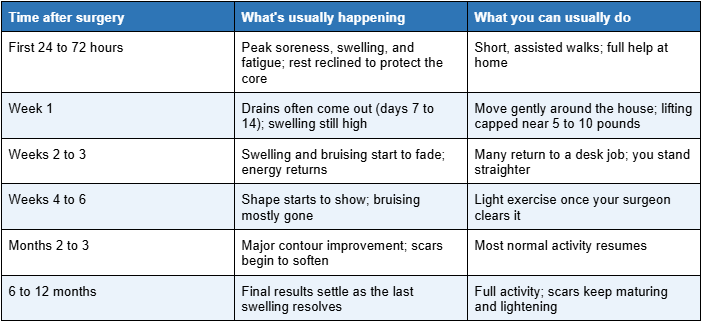
The first 24 to 72 hours are the most demanding, with soreness and tiredness at their peak. This is the stretch when you'll lean on others most, and that's exactly how it's supposed to go.
It's normal to have a day in that first week where you feel discouraged and wonder if it was worth it. Almost every mom hits that moment, and almost every one of them turns the corner soon after, as swelling drops and energy returns.
At Acadia Women's Health, our surgeons map a realistic timeline with you before surgery, so you know what each week should look like for your plan. When you're ready, you can book a free consultation to see what recovery would look like for you, with no pressure to decide that day.
The honest answer is that one procedure sets the pace for the rest. Knowing which part takes longest helps you plan the weeks ahead with clear eyes.
A tummy tuck is usually the longest part of recovery. The surgeon often repairs diastasis recti, the separation of the belly muscles that pregnancy can leave behind. Those stitches act like an internal corset, so you'll walk slightly bent forward for a week or two and keep lifting light for about six weeks while everything knits back together.
A breast lift tends to heal faster than the tummy. The soreness is real for the first several days, but the restrictions ease sooner because there's no muscle wall to rebuild.
A breast augmentation follows a similar, quicker path. Most of the early discomfort is tightness and pressure that softens over the first couple of weeks.
Liposuction areas mainly bring bruising and swelling rather than incision pain, and a compression garment does a lot of the work of settling them down.
So the breast and liposuction parts often feel manageable within days, while the tummy keeps you cautious longest. That's why the abdomen, not the chest, usually drives how soon you feel like yourself again.
A smoother recovery is mostly built before surgery day. The moms who feel calmest afterward are usually the ones who set everything up while they still felt good.
Stock your supplies ahead of time. Fill your prescriptions, have your compression garment ready, and gather everyday helpers like extra pillows for propping up, gentle gauze, easy snacks, and plenty to drink.
Build a recovery station where you'll spend those first days. Keep your medications, phone charger, water, remote, and clean bedding all within arm's reach, so you're not stretching or twisting to grab anything.
Plan for help with your kids, because this is the part moms worry about most. You won't be able to lift much, often nothing heavier than five to 10 pounds, which includes a baby or toddler, for the first few weeks. Arranging hands-on help for at least the first five to seven days takes that pressure off you.
This is also one practical upside of combining your procedures. With a mommy makeover, you plan one window of help rather than taking time off again and again, which is far easier on a busy family.
It's one reason so many women choose Acadia Women's Health, where cosmetic surgery, women's health, and recovery support all sit under one roof. Our cosmetic surgery patients often leave with their surgeon's personal cell number, so a question during recovery reaches a real person who knows you.
Patsy felt looked after by our Crowley team even with little ones in tow.
"I had my appointment there on a Friday for my Pre-Op and had to end up bringing 3 of the kids I babysit and they still welcomed me and even watched the the 2 boys while I went to the back with the baby. They made sure we were all comfortable and treated us all like family!"
The cost of time off can feel like one more thing to juggle. Our flexible financing options through Cherry, Affirm, and CareCredit can spread payments into manageable monthly amounts, so planning your recovery doesn't have to mean planning around one big bill.

Good aftercare is mostly a handful of simple habits done consistently. None of it is complicated, and your team will walk you through every step.
Care for your incisions gently. Leave your dressings in place as instructed, usually for the first one to two weeks, and once you're cleared to shower, let clean water run over the area rather than scrubbing it. Harsh products like hydrogen peroxide aren't needed and can irritate healing skin.
If you have drains, your job is simple but important. You'll record how much fluid comes out each day, and your surgeon removes the drains once that amount drops low enough, often somewhere between days seven and 14.
Pain is usually more manageable than women expect. Most surgeons now lean on a mix of non-narcotic medicines like acetaminophen and ibuprofen, with stronger medication kept only for breakthrough pain. In fact, research finds that prescription refills after surgery are uncommon, happening in about 4 percent of cases, so many women are left with medication they never use.
For scars, patience pays off. Once your incisions have closed, usually around two to three weeks, silicone gel or sheets can help them soften and fade over the months that follow.
You can also message the team anytime through the patient portal, the secure online account where your records and care details live.
Getting back to your life happens in stages, and gentle movement is part of healing, not a break from it. Light walking around the house is encouraged from day one, because it keeps your blood flowing and lowers the risk of clots.
Light chores can wait until the first few days are behind you. Pushing too hard too soon tends to mean more swelling, not faster healing, so it is genuinely the quicker path.
Returning to work depends on what your day demands. A desk or remote job is often doable around two weeks, while a physically demanding job needs longer. One study of body procedure patients found the average return to work was about four weeks, so it helps to plan generously rather than count on the earliest possible day.
Driving comes back once you're fully off prescription pain medication and can move and brake without hesitation, usually around 10 to 14 days. Light cardio like easy walking often resumes around four to six weeks, with core workouts and heavier exercise saved for later, once you're cleared.
This is where having an accessible team matters. At Acadia Women's Health, our surgeons clear you for each step based on how you're actually healing, not a fixed calendar, so you're never guessing whether you're ready.
Crystal found her own return to normal smoother than she expected.
"I'm a very happy camper. My procedure went smoothly, and I experienced very little downtime during recovery. He made the entire process comfortable and stress-free, and I would highly recommend him for any procedures."
When you're a little further along and want to picture the payoff, you can view real before-and-after results in our gallery to see where this recovery is heading.
Knowing what's expected takes a lot of the worry out of recovery. Most of what you'll feel in the early weeks is simply your body healing on schedule.
Swelling is the big one, and it follows a pattern. It builds early on and then eases over the first couple of weeks, with the last bit settling over the months that follow. Bruising shifts from purple to green and yellow before clearing, and numbness around the incisions is common as nerves slowly wake back up.
A seroma, a small pocket of fluid your body usually reabsorbs on its own, and a hematoma, a bit of pooled blood, can happen, but both are uncommon and very treatable when caught early. None of this means something has gone wrong; it's the ordinary work of healing.
That said, a few signs are worth a prompt call. Reach out to your surgeon if you notice spreading redness, warmth, or thick discolored drainage, a fever, or sudden swelling that's much worse on one side. Sudden shortness of breath, chest pain, or pain in your calf needs immediate care, so call your surgeon or emergency services right away.
This is exactly where Acadia Women's Health earns its reputation for being reachable. Because many of our cosmetic surgery patients have their surgeon's personal cell number, a worry at nine at night gets a real answer instead of a sleepless wait.
Adelaide felt supported through the parts that made her nervous.
"I was very anxious about the actual surgery part because I haven't had a surgery in so long and he held my hand every step of the way and kept the most infectious positive attitude as well."
Remember that worry about who would run the house while you healed? The truth is that recovery from a mommy makeover is a season, not a permanent state. With a plan and a little help, most moms move through it steadily and come out feeling more like themselves.
A good next step is simply gathering information. Looking at real before-and-after results can help you picture the finish line. When you feel ready, you can reach out to our team for a free consultation and honest answers about your own timeline.
At Acadia Women's Health in Crowley, we're here to help you plan recovery around your real life in Acadiana. There's no pressure to decide today; when you're ready, call us to schedule at 337-785-2006.

Written by
Cosmetic Surgeon, Board-Certified Urogynecologist
Fellow of the American Academy of Cosmetic Surgeons; Fellow of the American College of Obstetricians and Gynecologists. Medical Degree: University of Miami School of Medicine; Residency: Orlando Regional Healthcare System as Chief Resident.
Our board-certified team offers personalized, judgment-free consultations to help you decide what's right for you.
RECENT POST
BROWSE BY CATEGORY
VISIT US
527 Odd Fellows Road STE B
Crowley, LA 70526
(337) 514-4369
Mon – Thu 8:00 – 5:00
Friday 8:00 – 12:00
%20(SM).png)
(sm).png)
(SM).png)