Acadia Women's Health
June 23, 2026
min read

You have already made the big decision. You want a mommy makeover, and you are ready to feel like yourself again after pregnancy and breastfeeding. Then a second question shows up that you did not expect.
Should you do everything in one surgery, or space the procedures out over time? It is a fair thing to wonder about, and there is no single right answer. The better choice depends on your body, your health, and the life you are coming home to.
Here is the reassuring part. For the right candidate, combining procedures in one surgery is both common and safe. In a multi-institutional analysis of nearly 7,900 women covering 2008 to 2021, having breast and abdominal procedures together did not significantly raise overall complications compared with the tummy procedure done alone.
At Acadia Women's Health in Crowley, Louisiana, we help women across Acadiana think this exact choice through with honest, realistic guidance. This article walks you through the difference between the two approaches, the pros and cons of each, how to tell which one fits you, and what recovery looks like either way.
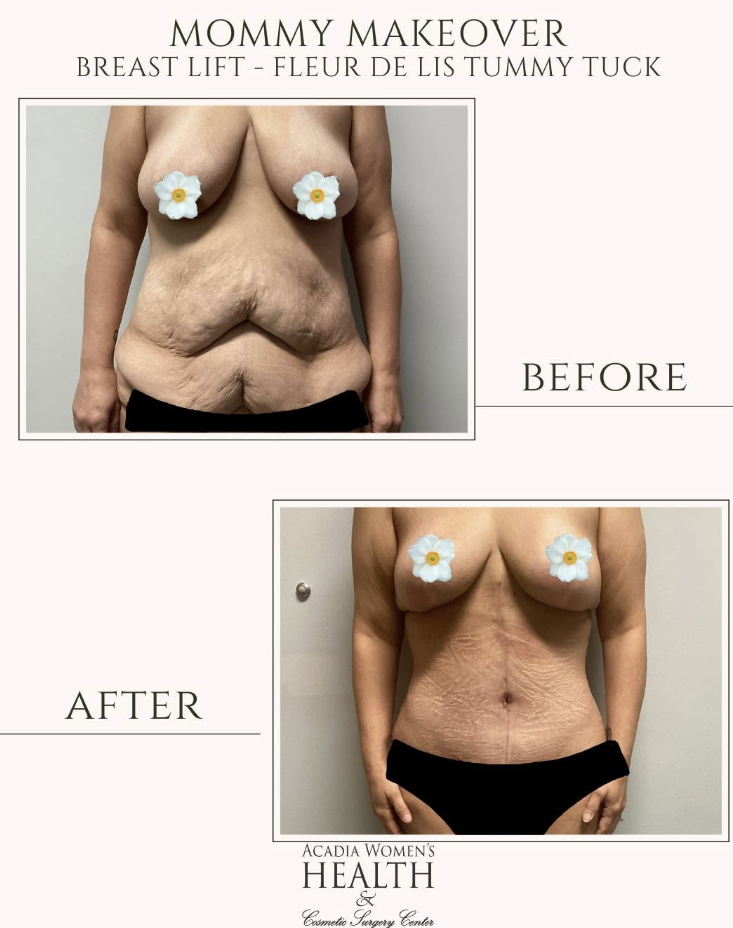
The difference comes down to how many trips to the operating room your plan takes. A single-stage mommy makeover does everything in one session, while a staged plan divides the work across two or more surgeries on different days.
In a single-stage approach, your surgeon combines the procedures you need into one operation under one round of anesthesia. A common combination pairs a tummy tuck with breast surgery, often with some body contouring added in. Most of these surgeries run about three to five hours, and you heal from everything during one recovery period.
A staged plan takes the same goals and spreads them out. The procedures are separated into two or more operations, usually a few months apart, so your body fully heals and the swelling settles between each one. Liposuction of several areas, for example, might be handled in its own session rather than piled onto a longer surgery.
Which procedures get combined and which get separated is really about safety and balance. A straightforward breast augmentation pairs comfortably with a tummy tuck for most healthy women.
More involved work is more often separated. A complex breast lift combined with extensive liposuction across several areas, for example, is usually staged to keep operating time and healing demands reasonable.
So neither approach is the standard and neither is a compromise. They are two valid routes to the same destination, and the rest of this article helps you see which one likely fits you best.
The appeal of a single-stage surgery is simple: you go through everything at once. One operation, one round of anesthesia, one set of facility fees, and one recovery window instead of several. For a busy mom juggling work and kids, doing it all at once can be the most practical path.
There is a real cost advantage too. Combining procedures means you are not paying separate facility and anesthesia fees for two or three different surgery days, which is part of why a combined plan is often more affordable than spacing things out. Many women also like that they take time off work only once.
This is exactly what so many of our patients choose. At Acadia Women's Health, our cosmetic procedures are performed in three fully accredited, in-office surgical suites, and we have completed more than 5,000 cosmetic surgeries in them. Combining procedures is a well-traveled path here. Anesthesia is always matched to your surgery, whether that is a local numbing solution that keeps you awake and comfortable, or sedation managed by a certified registered nurse anesthetist so you sleep.
There is good evidence behind the popularity of combining. In a 2022 report from the American Society of Plastic Surgeons, 80 percent of surgeons said their patients wanted to combine procedures for shorter recovery times and longer-lasting results. Doing it once also means going under anesthesia once, which lowers your total exposure.
Now for the honest trade-off. A combined recovery is more physically demanding, because you are healing your chest and your abdomen at the same time. The first week or two asks the most of you, which is exactly why the right candidate and a carefully run, accredited setting matter so much.
The takeaway is encouraging. For a healthy woman with good support at home for the first week or two, a single-stage surgery is a safe, efficient way to reach her goals. When you want to talk through whether you are a good fit for combining, you can schedule your free consultation and get a straight answer.
Staging takes the opposite approach, and for some women it is the smarter one. By splitting your plan into two or more surgeries, each operation is shorter and gentler, and each recovery is lighter than one big combined healing window would be.
The clearest benefit is safety for higher-risk situations. When a plan would otherwise mean a very long time in the operating room, staging keeps each surgery within a safer window. Operating times beyond about five to six hours tend to raise risks like blood clots. So for women with a higher body mass index, certain health conditions, or a history of clotting, spacing procedures out is frequently the more responsible call.
Staging can also sharpen your final result. Your surgeon can treat one area, let it fully heal, and then plan the next stage around how your body actually settled. That leaves room to refine things like symmetry and contour with the benefit of hindsight, which can make a real difference for very extensive body contouring.
The trade-offs are time and money. Two surgeries mean two facility fees, two rounds of anesthesia, and two recoveries to schedule around your family, so a staged plan usually costs more and stretches the overall timeline across many months. The good news is that cost does not have to be a barrier. We can talk through financing through Cherry, Affirm, and CareCredit, so you can plan a staged path around your budget rather than paying for everything at once.
Samantha found that being heard made the whole decision easier.
"She was incredibly caring and sweet, and most importantly, she truly listened."

The honest answer is that the right approach is a personal one, decided with a surgeon who knows your full picture. A few clear factors point the way, and most of them have nothing to do with what is trendy.
A single-stage surgery tends to be the best fit when a few things line up. You are in good general health, with a stable weight in a healthy range. Your procedure list is moderate, and you have steady help at home for the first week or two. In that situation, combining is safe, efficient, and gets you to one recovery instead of several.
Staging becomes the wiser choice when the picture is more complex. A higher body mass index, health conditions that affect healing, smoking, or a very large multi-area plan all push toward spacing things out. Limited help at home matters too, because a combined recovery asks a lot of your household in those first days.
You might be wondering, "Will they really listen to me, or just push me toward what is easiest?" That is a fair question. It is exactly why our consultations are built as a conversation, not a sales pitch. Your free consultation is a personal, one-on-one visit with one of our providers. They review your goals, explain what is realistic for your body, and recommend the approach that genuinely fits you, with no pressure to decide that day.
That is also where the practical pieces come together, like cost, financing options, and timing around your work and your kids. We take the time because this is a personal decision, not a quick transaction, and you should leave with clear answers either way.
When you are ready, you can book your free consultation and start with an honest conversation.
Recovery is where the two approaches feel the most different, so it helps to picture each one before you choose. The total healing is similar in the end, but the shape of it is not.
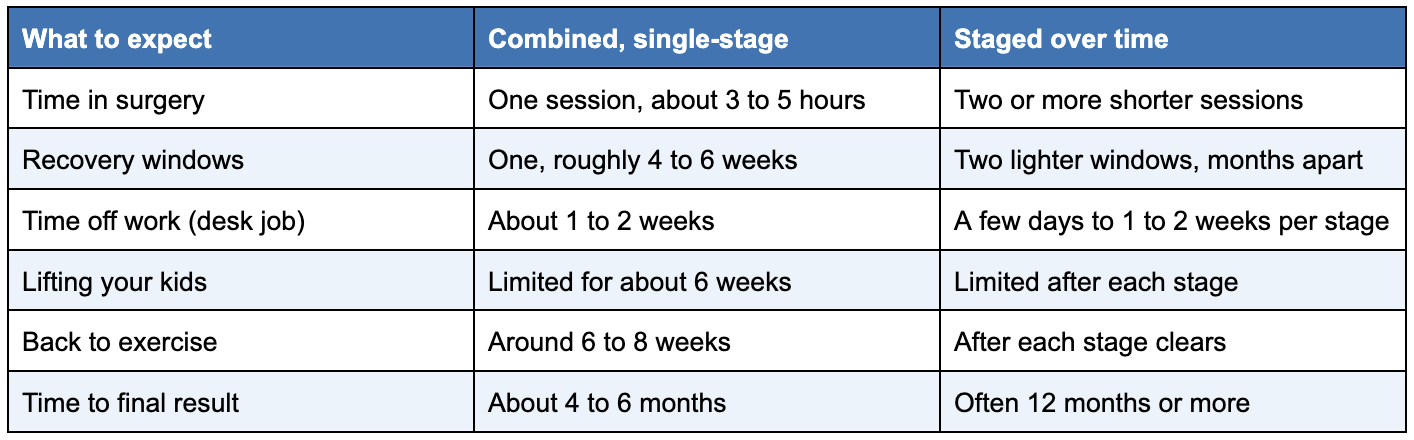
With a combined surgery, the first one to two weeks are the most demanding. You are healing your breasts and abdomen at once, wearing compression garments, and leaning on help with daily tasks and young children. If your plan includes muscle repair, you may stand a little bent for a week or two before you straighten up fully, and short, gentle walks start right away to keep your circulation moving.
A staged plan softens each of those weeks by splitting them up. The tummy stage might ask for two to three weeks of lighter recovery, and the breast stage a separate one to two weeks months later. You go through recovery more than once, but each round is gentler and easier to fit around your life.
Here is how the two timelines generally compare:
Whichever path you choose, the days after surgery are when accessibility matters most. At Acadia Women's Health, our cosmetic surgery patients get a surgeon's personal cell number after surgery, so you are never left guessing during recovery. You can also reach the team through the patient portal between visits.
Russie felt steady through the whole process because nothing was left unexplained.
"Dr Balder took the time to explain everything and made sure I felt confident throughout the entire process."
Remember that second question you did not expect, the one about whether to do it all at once or spread it out? It feels big right now, but it is a question with a clear answer once someone looks at your health, your goals, and your life. A mommy makeover can be shaped either way, and both paths lead to feeling like yourself again.
A good next step is simply to see what is possible. Looking through real before-and-after results can help you picture what either approach might do for you.
From there, the only way to know which path truly fits is an honest conversation. When you are ready, you can reach out to our team, with no pressure to decide anything that day.
For more than 25 years, Acadia Women's Health in Crowley has helped women across Acadiana make this decision with clear answers and real support. We understand the body you have and the body you want, and we are here whenever you are ready. You can call us to schedule at 337-785-2006.
Written by
Cosmetic Surgeon, Board-Certified Urogynecologist
Fellow of the American Academy of Cosmetic Surgeons; Fellow of the American College of Obstetricians and Gynecologists. Medical Degree: University of Miami School of Medicine; Residency: Orlando Regional Healthcare System as Chief Resident.
Our board-certified team offers personalized, judgment-free consultations to help you decide what's right for you.
RECENT POST
BROWSE BY CATEGORY
VISIT US
527 Odd Fellows Road STE B
Crowley, LA 70526
(337) 514-4369
Mon – Thu 8:00 – 5:00
Friday 8:00 – 12:00
%20(SM).png)
(sm).png)
(SM).png)